Fiber Optic Sensing for the Next Generation of Defense
This event has been postponed. Defense Tech Valley 2026 was announced for 16 and 17 September in Lviv, and the organizers postponed it in July 2026 after a missile strike on a private training ground in the Kyiv region during an arms exhibition. Brave1 has said the summit will return with new dates and an updated format, and those dates have not been announced. What follows is a description of the event, drawn from its 2025 edition, and of why sensing for critical infrastructure belongs in the conversation it hosts.
What Defense Tech Valley is
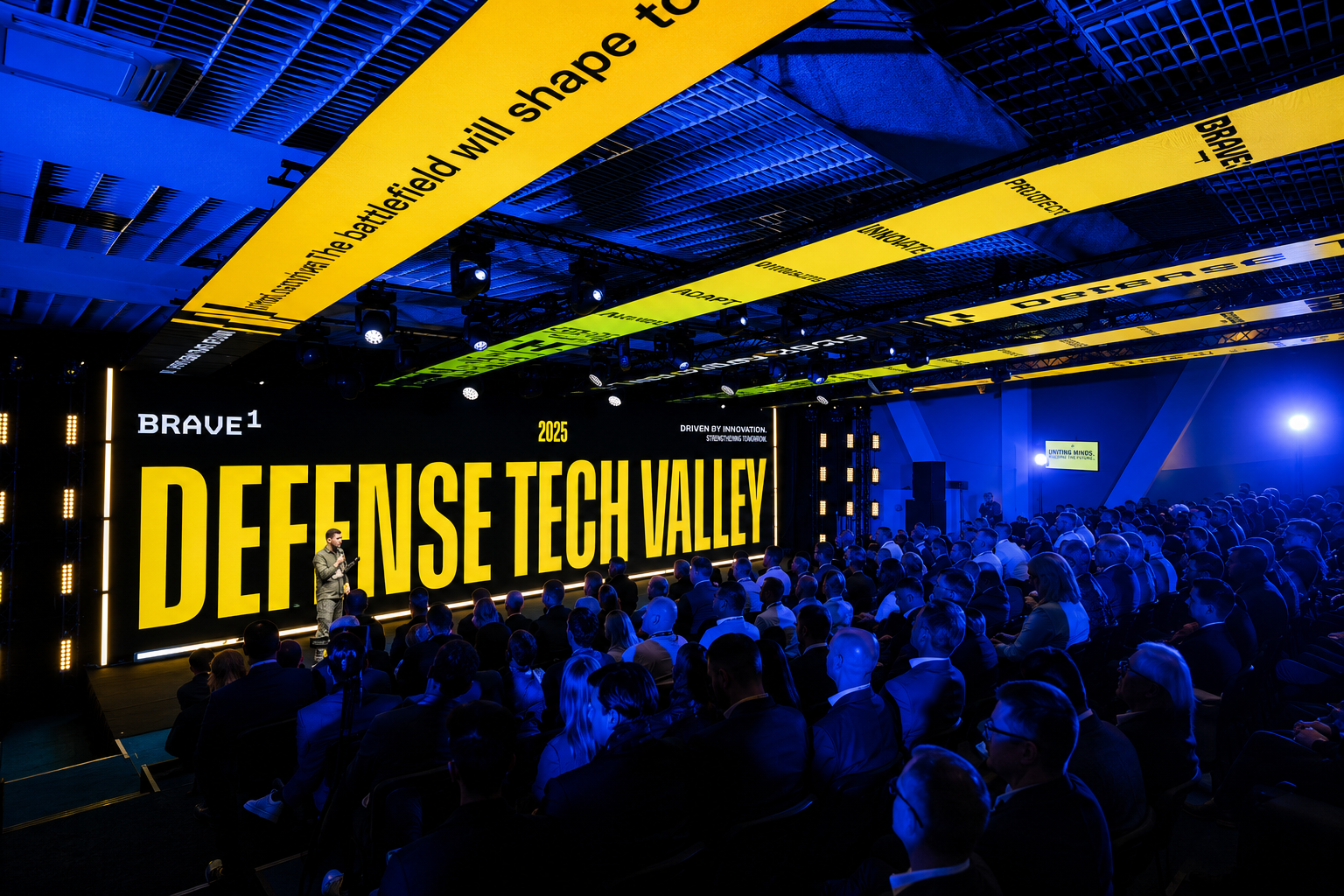
Defense Tech Valley is the largest defense technology summit held in Ukraine, run by the Brave1 cluster together with the Ministry of Defense and the Ministry of Digital Transformation. It is built as an investment event rather than a conventional trade fair: the purpose is to put developers whose systems are in use at the front in the same room as the funds and government buyers who can scale them.
The 2025 edition, held in Lviv on 16 and 17 September, gives a concrete picture of the scale:
- More than 5,000 attendees from over 50 countries, across developers, end users, investors and policymakers.
- More than 300 investors from Europe and North America, roughly double the number at Brave1’s previous major event in February of that year.
- More than 230 exhibiting manufacturers, Ukrainian and international.
- Battle Proven, a competition for defense and dual-use startups in three categories: Trail Blazers, Gamechangers and Power Players. Eligibility is tied to whether the technology is already deployed at the front or planned for frontline use, which is an unusual entry requirement and tells you what the event values.
The program covered artificial intelligence in defense, investment strategy for the sector, the commercialization of technology developed under wartime conditions, and cooperation between Ukraine, the EU, NATO and allied partners. An EU delegation took part in that last strand directly.
Where sensing for critical infrastructure gets argued about
Most defense technology conferences discuss capability in the abstract. This one selects for systems that have already been used, which changes the questions being asked. Instead of how sensitive an instrument is under test conditions, the discussion tends toward how it behaves when it is unattended for months, when the terrain is not cooperative, and when the people reading its output are not the people who specified it.
Those are exactly the questions that decide whether a distributed sensing deployment is useful, so it is worth stating our position on them plainly.
A sensor with nothing to detect
In a distributed acoustic sensing deployment, all the electronics sit in one cabinet. The asset in the field is standard optical fiber, which draws no power, emits nothing and has no radio signature. There is no device along the route to locate, disable or exploit, and a buried cable is difficult to distinguish from the communications cable it usually is.
That property is what makes the technique relevant here, more than raw sensitivity. A monitoring line that cannot be enumerated by looking for emissions is a different proposition from a chain of powered devices.
What sensing for critical infrastructure can detect
An interrogator reads vibration and acoustic energy along the whole cable and resolves each event to a position on it. Our Eagle DAS covers up to 50 km of fiber per channel from a single end, 100 km with optical repeaters, with channel spacing from 0.1 m and acquisition up to 10 kHz. Within that, the signatures that separate reliably are:
- Movement on foot, including a single person crossing a buried line.
- Vehicles, distinguishable by weight class and speed as they move along or across the route.
- Excavation and tunneling, which is mechanically loud and sustained.
- Interference with the cable itself, including cutting attempts.
- Impacts and detonations, locatable along the covered length.
The operational value is the combination of coverage and position. A perimeter with no gaps, reported as a distance along a known route, is what turns a detection into a response rather than a search. That is the same principle behind our security detection work.
What a sensing for critical infrastructure deployment involves
Three practical points come up in every early conversation, and they are worth stating plainly rather than discovering during a trial.
The cable has to be coupled to the ground. A fiber lying loose in a duct detects far less than one in direct contact with soil. Where an existing communications cable is available its installation determines sensitivity, and sometimes the right answer is a purpose-laid cable along the section that matters most.
The interrogator location is a real constraint. All the electronics sit at one end, which means one protected, powered location covers up to 50 km of route per channel, or 100 km with optical repeaters. Where that cabinet can go often decides how a long border is divided into segments.
Classification is trained, not configured. Fixed thresholds do not survive contact with weather, livestock and farm traffic. The useful deployment model records a baseline for the specific route and keeps refining it, which means a system improves over its first months rather than arriving finished.
Where the difficulty in sensing for critical infrastructure is
Detection is the easy half. A long fiber at a high acquisition rate produces far more events than any watch floor can assess, and most of them are weather, livestock, traffic and agriculture. A deployment is only useful if classification is good enough that an alert means something, which is a data problem rather than an optical one, and it is where most of the engineering effort goes.
Two consequences follow. First, a system has to be tuned against the specific route: what is normal along a rail embankment is not what is normal along a border in open country. Second, the classifier improves with local data, so the useful deployment model is one that keeps learning after commissioning instead of shipping fixed thresholds.
Dual use in sensing for critical infrastructure
The same installation that watches a perimeter also watches the infrastructure it follows. Energy networks, pipelines, rail corridors and communications routes are both things to protect and things to keep running, and a single fiber supports both readings: intrusion and interference on one hand, and the condition of the asset on the other. For a defense or resilience budget, that overlap is usually what makes the case, because one deployment answers to two owners.
BiiSensing works on this intersection of distributed fiber sensing, data processing and critical infrastructure protection, in Latin America, Europe, Africa and the Middle East. When Defense Tech Valley announces new dates we will update this article.
Event details
- Event: Defense Tech Valley 2026
- Status: Postponed. The edition announced for 16 and 17 September 2026 in Lviv was postponed by the organizers in July 2026. New dates have not been announced.
- Venue: Lviv, Ukraine
- Organizers: Brave1, with the Ministry of Defense and the Ministry of Digital Transformation of Ukraine
- Official site: defensevalley.tech
- Previous edition: 16 and 17 September 2025, Lviv. Over 5,000 attendees from more than 50 countries, over 300 investors and more than 230 exhibiting manufacturers.
Talk to an Engineer and tell us what you need to monitor. We will tell you whether fiber sensing is the right fit, and how to deploy it.