Case Studies Industry Technology
Distributed Acoustic Sensing Applications: Five Field Cases, From Pipeline Tunnels to Roads

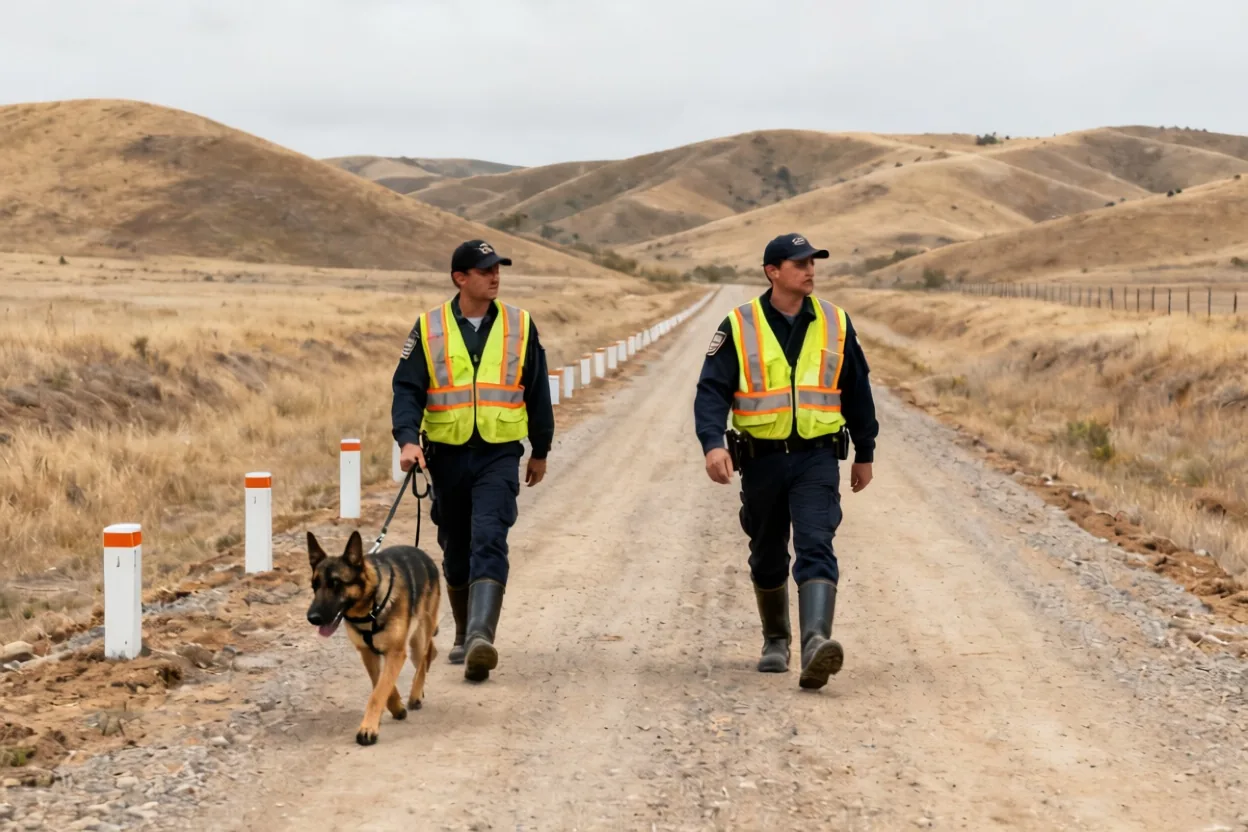
On 20 October, between 09:50 and 10:20, a dog working with a Pemex team in Pachuquilla, Hidalgo, changed its behavior. It started scratching the ground. Below the surface was a tunnel, at kilometer 190+000 of the 14-inch Tuxpan-Tula products pipeline, according to Milenio. That find is a good starting point for a practical question: what are distributed acoustic sensing applications actually doing in the field today?
This week the answer came from several places at once. Pipeline security in Mexico, road maintenance in Japan, earthquake detection on unused telecom fiber in California, and undersea cables all made the news. This article maps those cases. It does not define the technology again. For that, see our explainer on what distributed acoustic sensing is. Instead, it looks at where operators deploy DAS today, and where it reaches its limits.
Pipeline security: what a dog found, and what a fiber could hear
Patrols found the Pachuquilla tunnel. Pemex’s operational logistics intelligence unit worked with two canine teams, and one dog reacted at a specific spot. That method works. However, it depends on a patrol being in the right place at the right time.
Moreover, the scale of the problem explains why that matters. Official Pemex records cited by Industry & Energy Magazine put Hidalgo first nationally in the first half of 2026, with 1,474 illegal taps. Guanajuato, meanwhile, came second with 470. Within Guanajuato, Pénjamo recorded 172, Villagrán 61 and Cortazar 46.
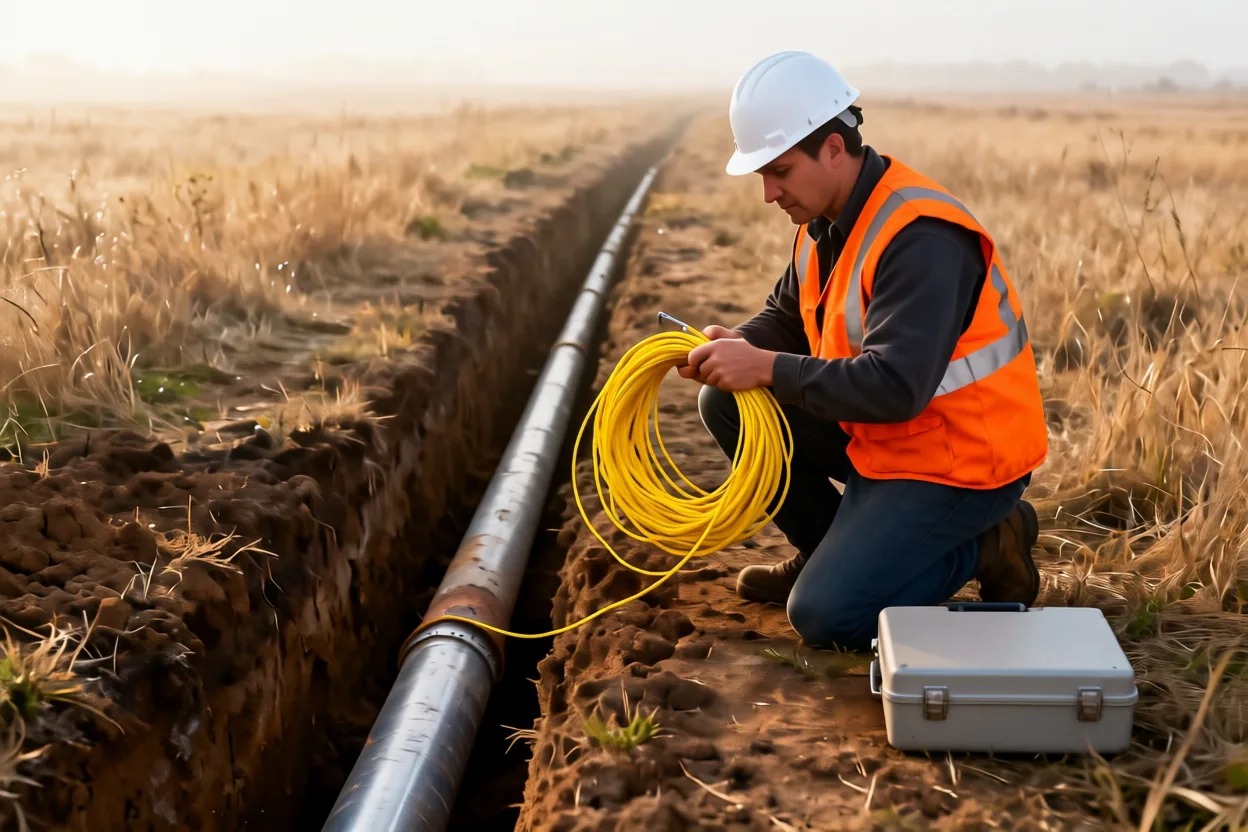
In contrast, a fiber cable along the right of way changes the logic. With DAS, the fiber itself works as a continuous line of vibration sensors. Therefore, digging near the pipe produces a signal tied to a position on the route, whether or not anyone is nearby. The system flags the event and its location, so a field team can check it.
This does not replace patrols. Instead, it tells patrols where to go. Detection performance depends on soil type, burial depth, the distance between fiber and pipe, and background noise from roads or pumps. For example, a cable in the same trench as the pipe behaves differently from one on a separate route. These conditions belong in a feasibility study before anyone discusses alarm rates. Our pipeline monitoring page explains how we approach that assessment.
Roads: a telecom operator puts its own fiber to work
On 15 October, Telecompaper reported that NTT East formed a five-company consortium with Kajima Corporation, OYO Corporation, Oriental Consultants and Mitsubishi Research Institute. The group plans to use “vibration, strain and temperature data collected through optical fibres installed beneath or alongside roads” for preventive maintenance. Its scope covers both road condition and traffic.
Two details stand out. First, the operator owns the fiber, so the sensing layer sits on an existing asset. Second, the project combines vibration with strain and temperature. That goes beyond acoustic sensing alone. For a road agency, the useful question is not which sensor to buy. Instead, it is which data supports a maintenance decision.
Earthquakes on dark fiber: DAS without new cable
In Northern California, Cal Poly Humboldt works with the U.S. Geological Survey and Vero Networks on a related idea. Jefferson Public Radio covered the project on 15 October. The team uses dark fiber, meaning unused strands in internet cables already in the ground, to detect seismic vibrations in Humboldt County. It also uses fiber from California’s middle-mile broadband expansion. The project is in its second year, and it aims to support operational earthquake early warning systems in the future.
Still, the lesson for infrastructure owners goes beyond seismology. Pipelines, railways and power lines often carry fiber for communications, and some strands may sit unused. As a result, a proof of concept on existing fiber can answer practical questions before any civil works start. We covered that approach in dark fiber sensing on existing infrastructure.
Undersea cables and defense: where the limits show
By contrast, submarine cables show the boundary clearly. An analysis from the Lowy Institute, dated 14 October, notes that on long-haul cables, DAS range “typically ends at the first repeater”. The same piece mentions SMART repeaters spaced “approximately every 100 kilometres”. In other words, DAS reads the segment before the first repeater, not the whole ocean crossing.
The article also raises a regulatory point. In February 2026, the ICPC “urged governments to exercise restraint in regulating cable sensing”. So far, that debate remains open. Therefore, any project on shared or third-party fiber should settle ownership, data access and permits early.
Maritime security is also drawing large industrial players. On 20 October, Marine Technology News reported that Optics11 signed a Strategic Collaboration Agreement with Saab. The goal is to “strengthen cooperation in the development of advanced underwater sensing and maritime security capabilities”. The deal builds on Optics11’s passive fiber optic sensing. In addition, the Netherlands Ministry of Defence chose its OptiArray system for the ASWINABO program.
Similarly, distributed acoustic sensing applications on land have their own limits. Range depends on the interrogator and on optical losses along the route. Splices, connectors and fiber condition all matter. Meanwhile, sensitivity changes with how well the cable couples to the ground. A serious assessment states these constraints at the start. In short, a vendor that promises zero false alarms has not spent much time in the field.
The signal is only half the system
Across distributed acoustic sensing applications, collecting vibration data is the easier part. However, interpreting it is where projects succeed or fail. The scientific community already treats analysis as a field of its own. For example, the Seismological Society of America held a topical conference on optical seismology from 13 to 16 October in Kona, Hawaii. SSA co-organized it with the COMBS center of the Australian Research Council. The program included “DAS in 3D” and a hands-on workshop on computational tools for DAS data.
For an operator, the same issue shows up as event classification. A system has to tell a backhoe from a passing truck, or a train from a landslide. That depends on the algorithms and on local reference data. In addition, it depends on alarm rules tuned to each segment of the route. Consequently, the same hardware can perform very differently on two sites.
How to evaluate distributed acoustic sensing applications on your route
The cases above share a pattern. Each one starts from a specific asset and a specific event to detect. Therefore, the first step on your own network is to answer three questions. Is there fiber along the asset, and are any strands available? Which events matter on each segment: excavation, leaks, traffic or ground movement? And what does your team do when an alert arrives?
BiiSensing works through those questions with infrastructure operators. We assess feasibility for a specific segment. We also run proofs of concept on fiber you already have in place. In addition, we support projects from the initial site survey through commissioning. If you manage a pipeline, a railway or a utility corridor, talk to our engineering team about your route.