Dark Fiber Sensing: Turning Cable You Already Own Into Sensors

The largest line item in most distributed monitoring projects is not the interrogator. It is putting cable in the ground. Dark fiber sensing avoids that cost entirely by using strands that are already installed and not carrying traffic, which for many operators turns a capital project into an equipment purchase.

What dark fiber is, and why there is so much of it
Fiber optic cables are manufactured with multiple strands, and installing a cable with 48 strands costs marginally more than installing one with 12. Since the expensive part is the trench and not the glass, network builders have consistently over-provisioned. The result is that a large share of installed fiber has never been lit.
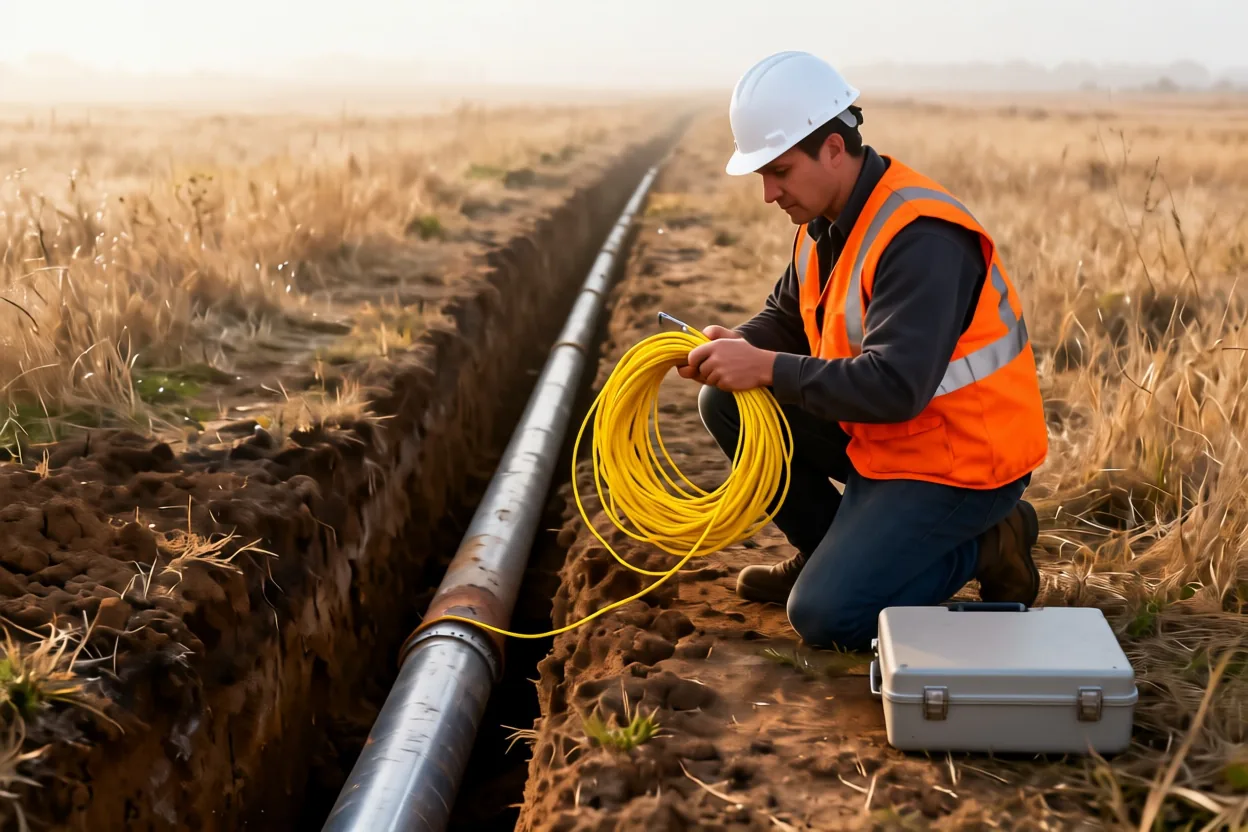
Those unused strands sit along exactly the routes that need monitoring: pipeline corridors, rail alignments, transmission lines, port estates and utility networks. The cable is already following the asset, because it was installed to serve that asset.
Why dark fiber sensing works on an ordinary telecom strand
Distributed sensing does not need special fiber. Standard single-mode fiber, the same G.652 used for telecommunications, is what most systems are designed around. Our Eagle DAS is specified on standard fiber for that reason, not on a special sensing cable.
The interrogator connects at one end, in a rack in an existing building, and reads the backscatter. Nothing is installed along the route and nothing needs power out in the field.
What to check before assuming it will work
- Continuity. The strand needs to be continuous over the section you want to monitor, without patches through equipment that would block the returning light.
- Loss budget. Splices and connectors add attenuation, and enough of them will shorten usable range below the nominal 50 km.
- Mechanical coupling. This is the one that decides sensitivity. Fiber in a loose tube inside a duct hears less than fiber in direct contact with the ground. It usually still works, but expectations should be set from a test rather than a datasheet.
- Who owns it. Often another department, or a telecom operator who leases capacity along your corridor.
Test dark fiber sensing before you commit
The sensible sequence is short. Identify a candidate strand, connect an interrogator for a few days, and look at what comes back on a section where you know what is happening: a road crossing with known traffic, or a scheduled excavation.
That test answers the coupling question directly and costs a fraction of a full deployment. It also tends to settle internal arguments quickly, because the data either shows the events or it does not.
When new cable is still the right answer
Dark fiber is not always available or suitable. If the route has no spare strands, if the existing cable is far enough from the asset that coupling is poor, or if the monitoring requires a specific cable construction, then installing purpose-laid fiber is the correct decision.
The point is to check first. In our experience the dark fiber sensing question is asked too late in the process, after a budget has already been built around new civil works that a spare strand would have made unnecessary.
How to find out what fiber you already have
The information usually exists, but rarely with the team that wants the monitoring. A short list of places to look:
- Network or telecom records for the corridor, including strand allocation.
- As-built drawings from the original installation, which often show more strands than the current records track.
- SCADA and control system documentation, since the fiber serving those systems typically follows the asset.
- Lease agreements with telecom operators along the route, which sometimes include unused capacity you are already paying for.
An OTDR trace on a candidate strand answers continuity and loss in an afternoon and costs almost nothing. That single measurement resolves most of the uncertainty.
Coupling: what decides dark fiber sensing sensitivity
Sensing measures what reaches the fiber, so how the cable is mechanically connected to its surroundings governs what the system can detect.
Cable in direct contact with soil couples well. Cable in a loose tube inside a duct, with air between it and the duct wall, couples less. Cable in a duct suspended in a chamber couples poorly at that point.
None of this is disqualifying, and plenty of productive systems run over duct-installed fiber. It does mean that sensitivity should be established by a short test on the actual strand rather than assumed from a specification sheet, particularly if the detection target is a subtle signature rather than an excavator.
What a dark fiber sensing proof of concept should cover
A few days of connection is enough to answer the questions that matter, provided the test is designed rather than passive. Arrange for a known event at a known location: a vehicle passing a specific point, or better, a scheduled excavation somewhere along the route.
If the system resolves that event at the right chainage with a clear signature, the coupling is adequate and the deployment is a matter of scale. If it does not, that is worth knowing before a budget has been built around it.
Explore where this applies across our seven solutions, or read about the instruments in our products.
Talk to an Engineer and tell us what you need to monitor. We will tell you whether fiber sensing is the right fit, and how to deploy it.
Frequently asked questions
What is dark fiber, and why is there so much of it?
Dark fiber is installed strands that are not carrying traffic. Fiber optic cables are manufactured with multiple strands, and because the expensive part is the trench rather than the glass, network builders have consistently over-provisioned. Those unused strands often follow pipeline corridors, rail alignments, transmission lines, port estates and utility networks.
Does distributed fiber sensing need special fiber?
No. Standard single-mode fiber, the same G.652 used for telecommunications, is what most systems are designed around, and the Eagle DAS is specified on standard fiber for that reason. The interrogator connects at one end, in a rack in an existing building, and nothing installed along the route needs power out in the field.
What should be checked before using an existing strand for sensing?
Four things. Continuity over the section to be monitored, without patches through equipment that would block the returning light. The loss budget, since splices and connectors add attenuation. Mechanical coupling, which decides sensitivity. And ownership, because the strand often belongs to another department or to a telecom operator that leases capacity along the corridor.
How do you test dark fiber before committing to a project?
Connect an interrogator to a candidate strand for a few days and arrange a known event at a known location, such as a vehicle passing a specific point or a scheduled excavation. If the system resolves that event at the right chainage with a clear signature, the coupling is adequate and the deployment is a matter of scale.