Fiber Optic Sensing in Latin America: Why Critical Infrastructure Can No Longer Wait


Across the region, the assets that matter most are also the hardest to watch: pipelines crossing hundreds of kilometers of open country, rail corridors through mountains, transmission lines over terrain where a service vehicle takes half a day to arrive. Fiber optic sensing in Latin America is moving from a technology operators had heard of to one they are specifying, and the reason is not that the technology suddenly improved. It is that the alternative, inspecting long assets by sending people to look at them, does not scale to the distances involved.

Why fiber optic sensing in Latin America is a different problem
Monitoring approaches designed for dense European networks transfer badly here, for reasons that are geographic rather than technical.
Distance. Assets run for hundreds of kilometers between population centers. A monitoring model that assumes a technician can reach any point within an hour does not describe a pipeline crossing northern Mexico or a transmission line through the Andes.
Seismic exposure. Much of the region sits on active margins (USGS). Ground movement is not an edge case to be handled by exception, it is a design condition for pipelines, tailings dams, tunnels and bridges.
Terrain. Routes cross jungle, desert, high altitude and coastline, often within one asset. Powered field instrumentation in those conditions means a power supply, an enclosure and a maintenance visit for every measurement point.
Fiber optic sensing in Latin America answers all three at once, because it puts no electronics in the field at all. The measurement happens in a cabinet at one end, and the cable does the sensing along its whole length.
The gap on long assets
The problem is rarely detection. It is coverage. Point sensors measure precisely where somebody decided to place them, and between two of them is a stretch nobody is watching. On a short asset that gap is manageable. On a 200 km route it is where the failure happens.
Pipelines
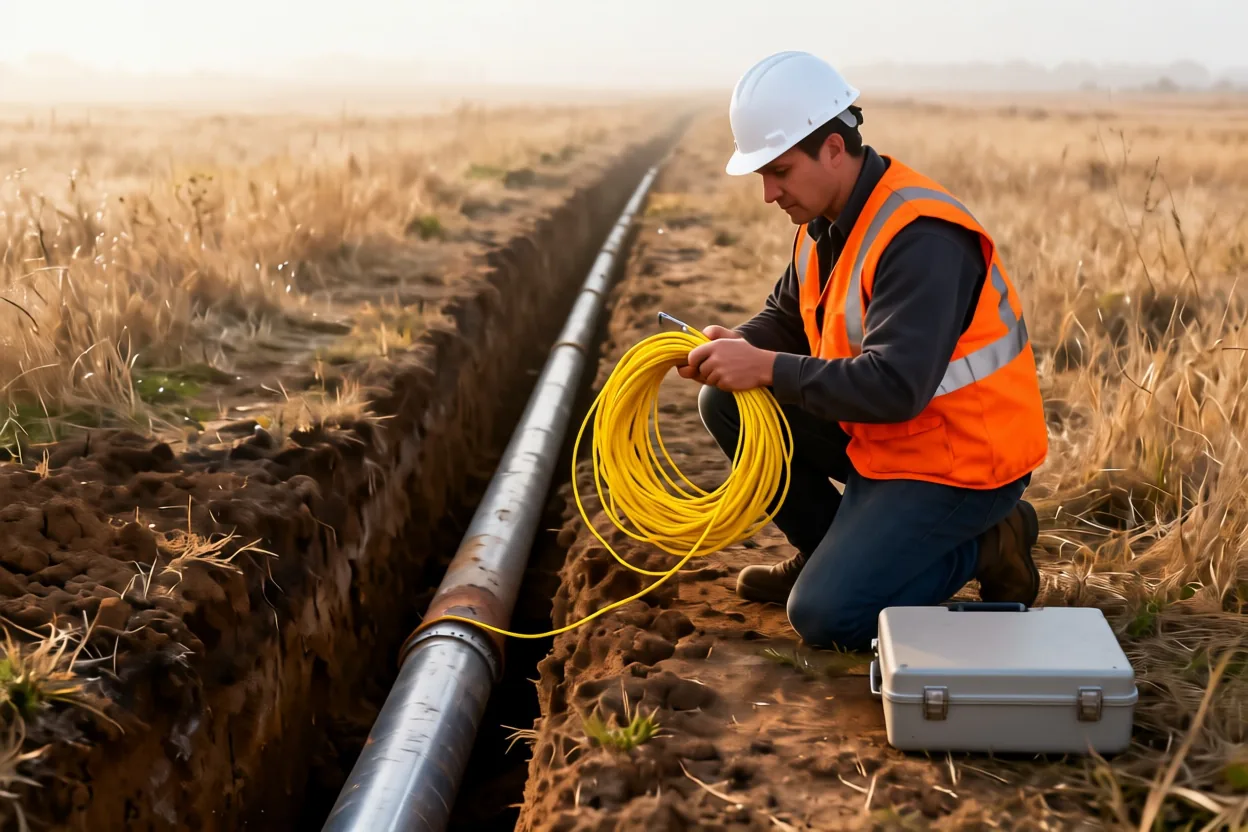
Pressure monitoring registers a loss once it is large enough to move the whole system. By then the product is already in the ground. DAS pipeline monitoring reads the acoustic signature of the line continuously, so a leak turning into turbulence and an excavator working above the pipe both register at a known distance, typically within a meter or so.
Railways
Most rail corridors in the region already have fiber alongside the track, installed for signaling or communications. That same fiber can report train position, speed and direction along the corridor (Zhang et al., Frontiers in Earth Science 2022), plus rockfalls, trespassing and cable theft, without a single trackside device needing power. For fiber optic sensing in Latin America, cable that is already there is usually the difference between a capital project and an equipment purchase.
Power cables
Cables fail thermally, at whichever point sheds heat worst, and that point moves with the season and the soil. Temperature sensing at every meter finds it wherever it currently is, and the same measurement supports carrying more current when conditions allow.
Bridges, tunnels and slopes
Inspection tells you the condition on the day of the visit. Distributed strain measured along a deck or a tunnel lining tells you what the structure has been doing since the last one, which in a seismically active region is a different quality of information.
What fiber optic sensing in Latin America changes
The shift is easy to state and easy to underestimate. A single optical fiber becomes thousands of measurement points. Our Eagle DAS covers up to 50 km per channel from a single end, 100 km with optical repeaters, sampling at up to 10 kHz. The Eagle DTS reads temperature at every meter over 30 km with 0.03 °C resolution across up to 4 channels.
Nothing along that route needs power, a battery change or an enclosure that survives the weather. For an operator whose asset crosses terrain where every site visit is a day of work, that is the property that decides whether continuous critical infrastructure monitoring in Latin America is affordable at all.
The cost argument that actually lands
The largest line item in a distributed monitoring project is usually not the interrogator. It is putting cable in the ground, and that single fact shapes most budgets for fiber optic sensing in Latin America.
Which is why the first question worth asking is whether the cable is already there. Pipeline corridors, rail alignments, transmission routes and port estates across the region were built with fiber for SCADA and communications, and fiber cables are routinely installed with more strands than the traffic needs, because the trench costs more than the glass. A spare strand turns a civil works project into an equipment purchase.
That check is a short conversation with whoever holds the network records, and it changes the budget by a multiple. It is also asked too late more often than not, after a case has been built around trenching that a spare strand would have made unnecessary.
Why the supplier’s location matters for fiber optic sensing in Latin America
A distributed sensing system is not a product you install and forget. It needs commissioning on the asset, classification tuned to the noise that specific route produces, and someone reachable when an alarm looks wrong at three in the morning.
Handled from another continent, each of those becomes a scheduling problem. BiiSensing is the first Latin American company dedicated to fiber sensing and data analysis through optical fiber, which in practice means engineers who can be on site, training delivered in Spanish or English to the people who will actually read the alarms, and support in the same time zone as the operation.
Our detection methods are built and validated alongside research centers across Latin America, then proven in field deployments before they reach a client’s asset. That matters because the background signature of a pipeline under a busy highway in Mexico is not the signature of one crossing farmland, and classification that was never exposed to the second will not perform on it.
Where to start with fiber optic sensing in Latin America
The useful first step is narrow. Pick the single asset where a failure would be least acceptable, and answer three questions about it: how would that failure announce itself physically, is there fiber already running along the route, and who would act on an alarm.
Those three answers determine most of the design. The specification follows from them rather than the other way around, which is the mistake most often made: choosing a system first, then discovering it measures something other than the thing that goes wrong.
See how this applies across our seven solutions, compare the instruments in our products, or read how pipeline monitoring and railway monitoring work in detail.
Talk to an Engineer and tell us what you need to monitor. We will tell you whether fiber sensing is the right fit, and how to deploy it.
Frequently asked questions
Why does fiber optic sensing suit infrastructure in Latin America?
Assets run for hundreds of kilometers between population centers, much of the region sits on active seismic margins, and routes cross jungle, desert, high altitude and coastline. Fiber sensing answers all three because it puts no electronics in the field: the measurement happens in a cabinet at one end, and the cable does the sensing along its whole length.
Which assets can fiber optic sensing monitor in Latin America?
Pipelines, where the acoustic signature of a leak or an excavator registers at a known distance; railways, where trackside fiber reports train position, speed and direction plus rockfalls, trespassing and cable theft; power cables, where temperature at every meter finds the hot spot; and bridges, tunnels and slopes, where distributed strain shows what a structure has been doing.
What is the largest cost in a fiber sensing project?
Usually not the interrogator. It is putting cable in the ground. Pipeline corridors, rail alignments, transmission routes and port estates across the region were built with fiber for SCADA and communications, often with more strands than the traffic needs. A spare strand turns a civil works project into an equipment purchase.
Why does the location of the supplier matter?
A distributed sensing system needs commissioning on the asset, classification tuned to the noise of that route, and someone reachable when an alarm looks wrong. BiiSensing is the first Latin American company dedicated to fiber sensing and data analysis through optical fiber, which means engineers on site, training in Spanish or English and support in the same time zone.