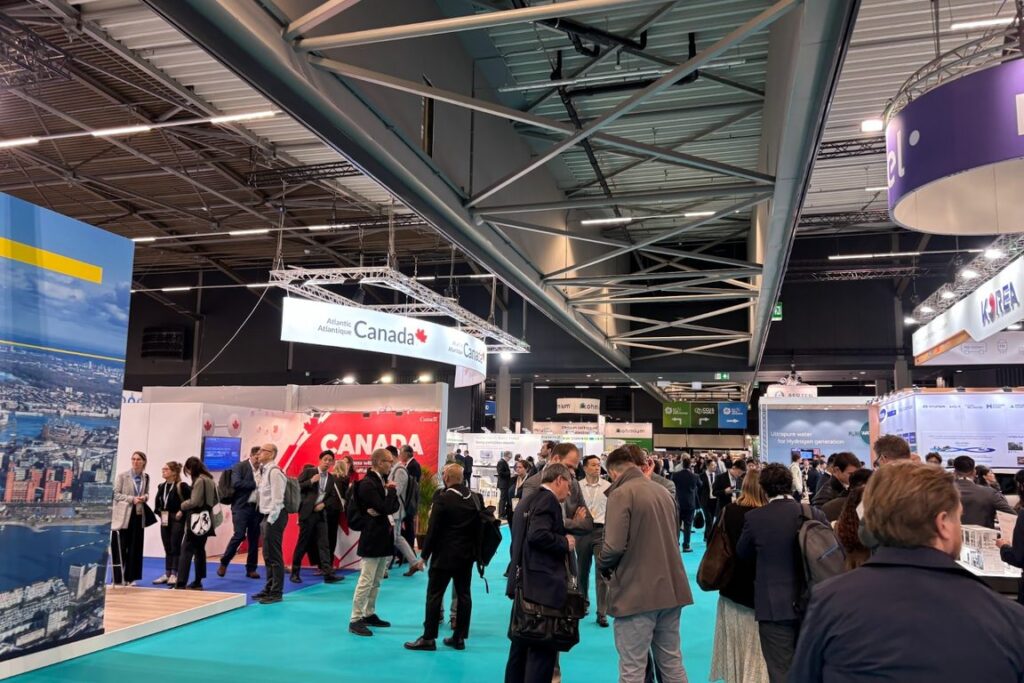
World Hydrogen Summit & Exhibition, Rotterdam 19 – 21 May 2026


Fiber Optic Sensing and the Growing Hydrogen Economy
The hydrogen buildout is, before anything else, an infrastructure project. Production plants, transmission pipelines, salt cavern and tank storage, port terminals and industrial offtake hubs all have to be built, and most of them are long, linear and sited where nobody is watching. That is why fiber optic sensing for hydrogen infrastructure is becoming part of the conversation at the design stage rather than after commissioning. The monitoring question arrives with the asset, not later.
BiiSensing attended the World Hydrogen Summit & Exhibition at Rotterdam Ahoy this May, alongside the co-located CCUS World Summit. What follows is less a report on the event than a summary of where we think distributed sensing fits in this market.
Why fiber optic sensing for hydrogen beats point instrumentation
The difficulty is not detection. It is coverage. Conventional instrumentation measures at the points where somebody installed a device, and the stretch between two devices is unobserved. On a compact plant that is manageable. On a transmission line running for tens or hundreds of kilometers across open country, the unobserved stretch is where the incident happens.
Three properties of hydrogen infrastructure make this worse:
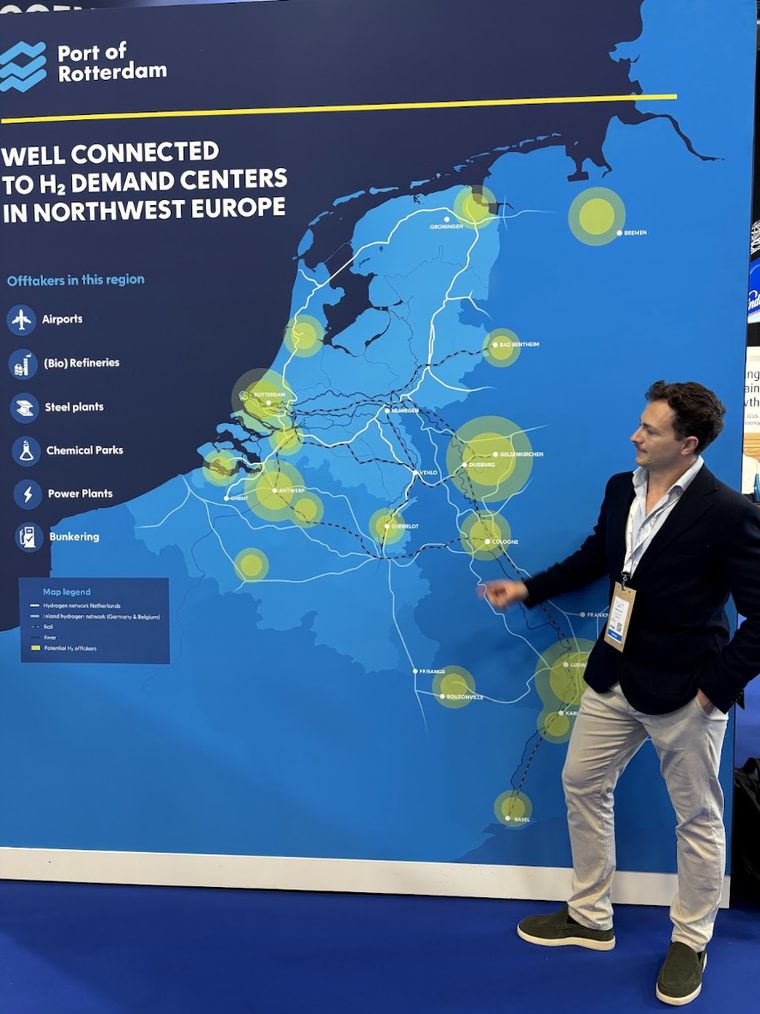
Distance. Transmission corridors connect production to demand centers that are far apart. A monitoring model that assumes a technician reaches any point within the hour does not describe a pipeline crossing a national border.
Consequence. Hydrogen is a small molecule with a wide flammability range. The tolerance for a slow, undetected loss of containment is lower than it is for many other products, which raises the value of detecting an event early rather than confirming it afterwards.
Powered field devices. Every instrument along a remote route needs a supply, an enclosure and a maintenance visit. Multiply that by the number of measurement points a long asset needs and the operating cost dominates the capital cost.
What fiber optic sensing for hydrogen infrastructure measures
Distributed sensing answers all three at once, because it puts no electronics in the field at all. An interrogator in a cabinet at one end sends light down a standard telecom fiber and reads what comes back. The cable is the sensor along its entire length, and the measurement resolves to a position on that length.
Three techniques do different jobs, and hydrogen assets tend to want more than one:
Distributed Acoustic Sensing reads vibration and acoustic energy. Our Eagle DAS covers up to 50 km of fiber per channel from a single end, 100 km with optical repeaters, with acquisition up to 10 kHz. In practice that means a pressurized release turning into turbulence and an excavator bucket working above the line both produce a signature at a known distance along the route.
Distributed Temperature Sensing reads temperature at every meter. Eagle DTS resolves 0.03 °C over distances of up to 30 km across up to 4 measurement channels. Compression, expansion and leakage all move heat, so a thermal profile along a line is a second, independent view of the same asset.
Distributed Strain Sensing reads mechanical strain, which matters where ground movement, subsidence or settlement can load a buried line or a storage structure. We deliver DSS in custom-engineered configurations rather than as a catalog product, because the useful measurement depends heavily on how the cable is coupled to the structure.
Where fiber optic sensing for hydrogen pays for itself
Safety is the argument that opens the conversation, but it is rarely the one that gets a monitoring budget approved. The operating numbers do more work:
- Fewer inspection kilometers. Continuous coverage changes routine patrol from a calendar activity into a response to something the system flagged.
- Earlier detection. Pressure-based methods register a loss once it is large enough to move the whole system. By then the product is already out.
- Maintenance that follows evidence. A thermal or acoustic history per location lets intervention be scheduled against a trend instead of a fixed interval.
- Less downtime. Locating an event to within about a meter is the difference between excavating once and searching a corridor.
The same reasoning appears across our pipeline monitoring work, and the hydrogen case is a stricter version of it rather than a different one.
Fiber you may already own
Most linear infrastructure was built with a communications cable in the trench, and much of that cable has unused strands. That is where fiber optic sensing for hydrogen usually starts. Those spare strands can often be read as a sensing asset without laying anything new, which changes the economics considerably: the largest cost in a distributed sensing project is usually the civil work, and here it is already paid for. We wrote separately about using dark fiber this way.
For operators, infrastructure owners and technology providers building out hydrogen capacity now, that spare capacity is worth auditing before the next trench is opened.
Event details
- Event: World Hydrogen Summit & Exhibition
- Dates: 19 to 21 May 2026
- Venue: Rotterdam Ahoy, Rotterdam, Netherlands
- Co-located with: CCUS World Summit & Exhibition
- Official site: world-hydrogen-summit.com
Talk to an Engineer and tell us what you need to monitor. We will tell you whether fiber sensing is the right fit, and how to deploy it.