DTS Power Cable Monitoring: Finding Hot Spots Before Failure

Power cables can fail thermally: operating above the rated temperature can cause premature insulation failure. Insulation degrades faster at higher temperatures, degradation concentrates at the hottest point, and the hottest point is rarely where anyone installed a sensor. DTS power cable monitoring, using Distributed Temperature Sensing, addresses that by measuring the whole route instead of sampling it.
Why the hot spot moves
A cable’s temperature at any point depends on the current it carries and on how well that point sheds heat. The second factor varies along the route in ways that are hard to predict from a design drawing.
A section in dry sand sheds heat poorly. A crossing under a road sits in backfill with different thermal properties than the surrounding soil. A duct bank shared with other circuits gets heat from its neighbors. A stretch that was fine when the soil was wet becomes the limiting point after a dry summer.
The result is that the thermal bottleneck is a property of the installation and the season (Ukil et al., IEEE Sensors Journal 2012), not something you can place a probe on in advance.
What DTS power cable monitoring measures
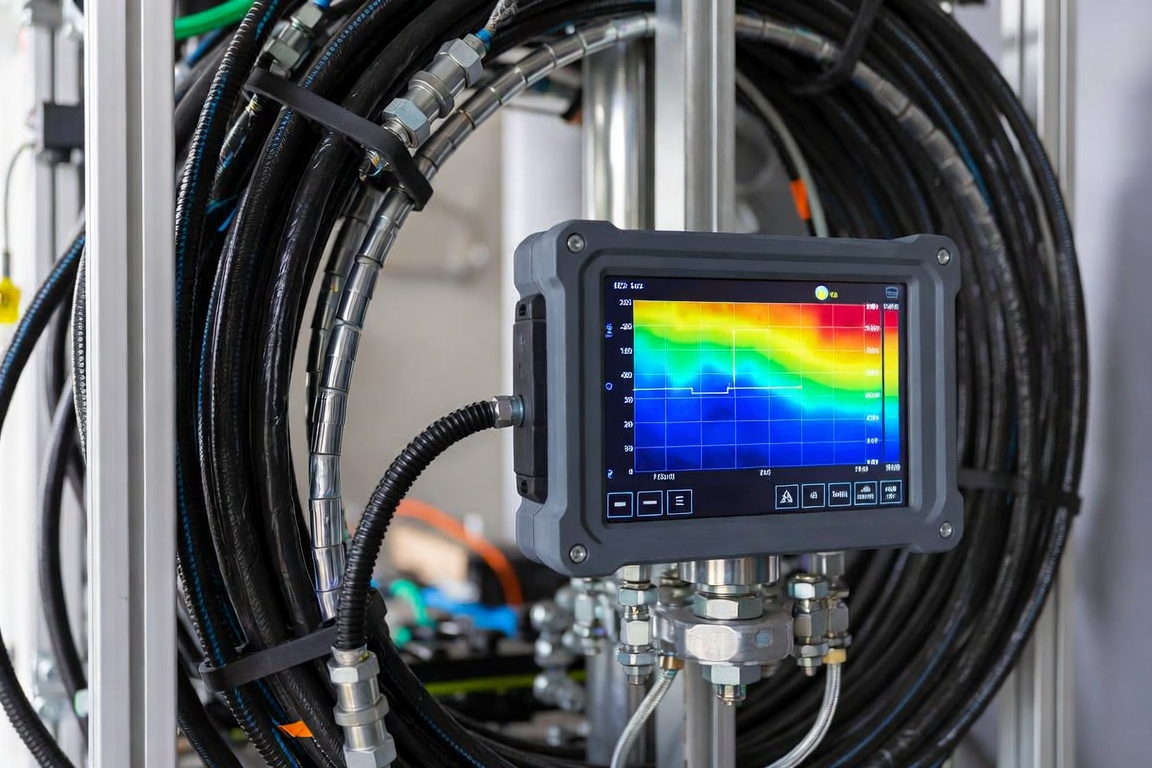
A DTS interrogator reads Raman backscatter along a fiber, whose anti-Stokes to Stokes intensity ratio changes with temperature. Our Eagle DTS covers up to 30 km with 0.03 °C resolution, 5 m spatial resolution and up to 4 measurement channels, so a single unit can cover several circuits.
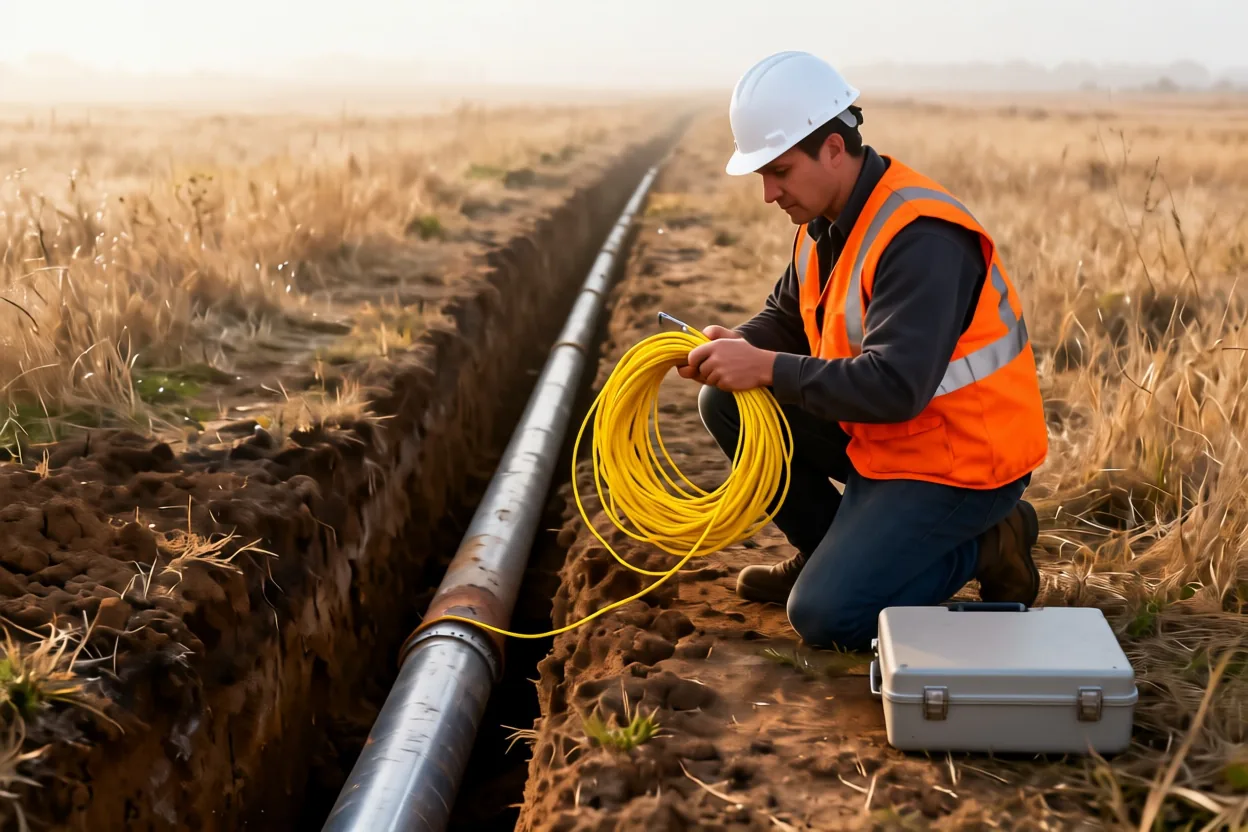
The fiber is often already there. Many transmission and distribution cables are manufactured with optical fiber in the construction, for exactly this purpose. Where it is not, a fiber can be pulled into a spare duct or laid alongside.
What the data supports
- Hot spot identification, continuously, wherever it currently is.
- Dynamic rating. Static ratings assume worst-case conditions everywhere. Measured temperature lets you carry more current safely when conditions allow, which is capacity you already own.
- Joint monitoring. Joints are a common failure point and run measurably warmer as they degrade.
- External heat sources, including new circuits installed nearby by somebody else.
Dynamic rating is usually where the money is
Security is the reason most utilities look at DTS power cable monitoring, but the return often comes from capacity. A circuit rated on conservative assumptions about soil thermal resistivity and ambient temperature is, most of the year, operating well below what it could safely carry (SINTEF and Elvia, CIRED 2023).
Continuous measurement replaces assumptions with the actual thermal condition of the actual route. For a network operator facing reinforcement costs, deferring a new circuit by using the existing one closer to its real limit is a substantial saving, and it is defensible because it is measured rather than modeled.
What DTS power cable monitoring does not do
DTS measures temperature. It will not detect a partial discharge, a mechanical strike or a fault as it happens: those are electrical and acoustic phenomena. Operators concerned about excavation damage alongside thermal performance generally run acoustic sensing over a second fiber in the same cable, which is why the two technologies are so often specified together.
What a dynamic rating program needs
Using measured temperature to carry more current is where most of the financial return on DTS power cable monitoring sits, and it takes more than an interrogator.
It needs a thermal model of the cable relating conductor temperature to the fiber’s measured temperature, since the fiber is not in the conductor. It needs agreement from asset owners on the temperature limit being managed to. And it needs the output to reach whoever dispatches the circuit, in a form their systems accept.
None of that is exotic, but a project scoped as an instrument purchase and nothing else will not deliver the capacity benefit that justified it.
Joints, terminations and the places heat concentrates
Failures cluster at joints. A joint is a hand-made discontinuity in an otherwise uniform cable, and a degrading one runs measurably warmer than the cable either side of it.
With 5 m spatial resolution, a warming joint stands out as a distinct feature along an otherwise uniform run. Trending the temperature differential between a joint and its adjacent cable, rather than its absolute temperature, removes seasonal variation and turns the reading into a condition indicator that means something on its own.
DTS power cable monitoring on circuits sharing a route
Cables installed in shared trenches and duct banks heat each other. A circuit rated in isolation may be operating well below its assumed capacity because a neighbor installed years later is contributing heat that no design document accounts for.
Continuous measurement along the whole route makes mutual heating visible and quantifiable. For network operators, this is frequently the finding that surprises them most, and it changes reinforcement planning because the constraint turns out to be somewhere other than the design predicted.
See the instrument on our Eagle DTS page, or how acoustic sensing complements it in cable monitoring.
Talk to an Engineer and tell us what you need to monitor. We will tell you whether fiber sensing is the right fit, and how to deploy it.
Frequently asked questions
Why do power cables need distributed temperature monitoring?
Insulation degrades faster at higher temperatures, degradation concentrates at the hottest point, and that point is rarely where anyone installed a sensor. It also moves, because how well each section sheds heat depends on the soil and the season. Distributed Temperature Sensing measures the whole route instead of sampling it, so the hot spot is found wherever it currently is.
What does DTS power cable monitoring measure?
A DTS interrogator reads Raman backscatter along an optical fiber, which changes with temperature, so it measures temperature along the whole cable route. The data supports continuous hot spot identification, dynamic rating, joint monitoring, and the detection of external heat sources such as new circuits installed nearby by somebody else.
What is dynamic rating and why does it matter?
Static ratings assume worst-case conditions everywhere, so most of the year a circuit operates well below what it could safely carry. Measured temperature lets an operator carry more current safely when conditions allow. For a network facing reinforcement costs, deferring a new circuit by using the existing one closer to its real limit is a substantial saving.
Can DTS detect partial discharge or excavation damage?
No. DTS measures temperature. It will not detect a partial discharge, a mechanical strike or a fault as it happens, because those are electrical and acoustic phenomena. Operators concerned about excavation damage generally run acoustic sensing over a second fiber in the same cable, which is why the two technologies are so often specified together.