Railway Monitoring with DAS: How a Single Fiber Replaces an Entire Sensor Network


Modern railways are among the most sensor-dense infrastructure environments in the world — axle counters, track circuit detectors, speed sensors, level crossing monitors. Each device requires installation, cabling, maintenance, and eventual replacement. Distributed Acoustic Sensing offers a fundamentally different architecture for railway monitoring: one fiber, continuous coverage, no trackside moving parts.

What Railway Monitoring with DAS Detects
As a train moves, its wheels generate a distinctive acoustic and vibrational signature in the rail (Kowarik et al., Sensors 2020). DAS interrogators measure these signatures in real time, allowing algorithms to determine:
- Position: Locate each train to within ±10 m along the entire monitored route
- Speed: Calculate velocity from how the position of the train changes over time
- Direction: Determine direction of travel from the temporal pattern of signal arrival
- Wheel health: Detect flat spots and anomalous wheel profiles from acoustic fingerprints
- Track anomalies: Identify loose fasteners, rail breaks, and ballast voids from vibration profiles
Railway Monitoring Inside Traffic Management
Eagle DAS outputs a real-time event stream via standard industrial protocols (MQTT, REST API, OPC-UA), integrating directly with train control systems, traffic management centers, and SCADA platforms. Latency from physical event to software notification is typically under 200 milliseconds — fast enough for safety-critical decision support.
Infrastructure Savings
The railway monitoring case that lands with operators is usually the sensor count. A regional rail operator that deployed DAS on a 210 km commuter corridor reported eliminating 340 individual trackside sensors in the first phase, reducing annual maintenance costs by 61% while extending monitoring coverage to sections that had previously been unmonitored due to installation complexity.
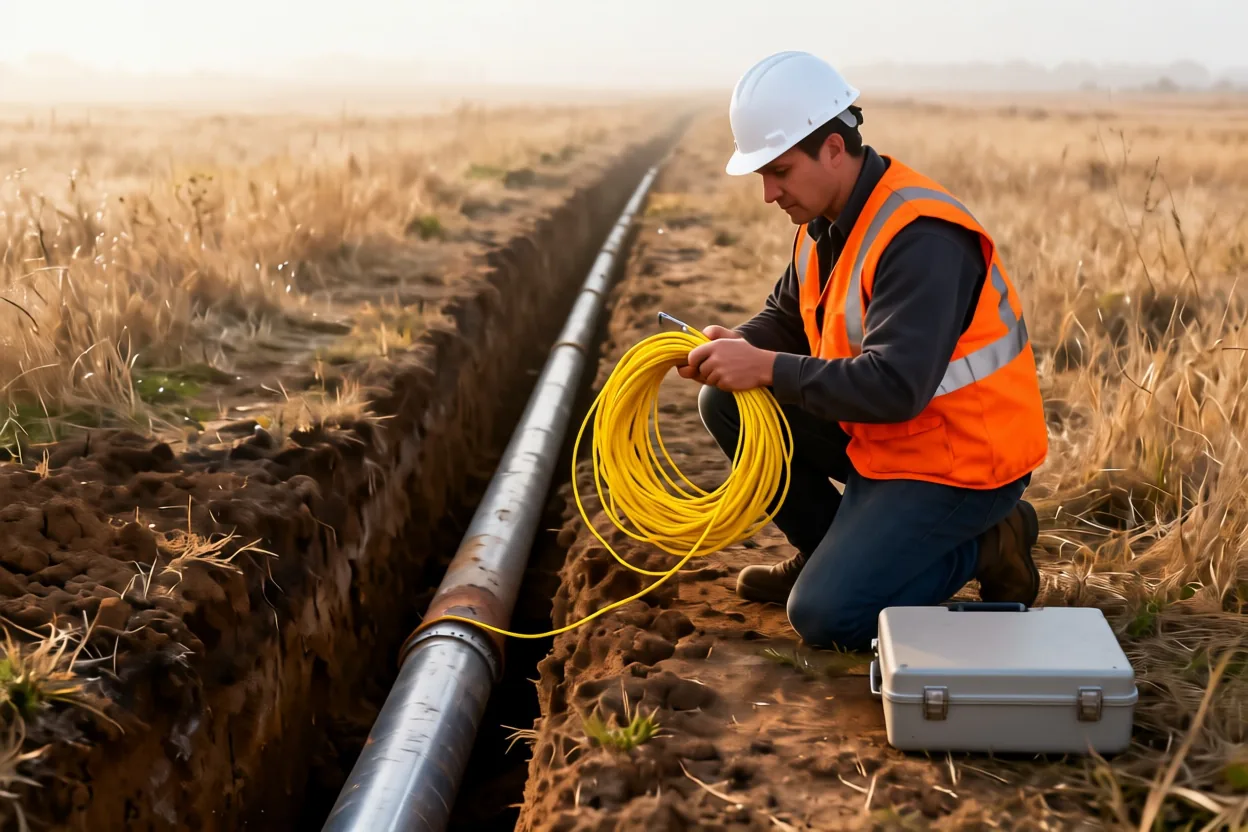
Most rail corridors already carry fiber alongside the track, installed for signaling or communications, which is what makes railway monitoring cheap to start where the cable is already in place. Where a spare strand exists, coverage can start with an interrogator in an existing equipment room and no trackside work at all, which is usually the difference between a capital project and an equipment purchase. See how railway monitoring works along a whole corridor on our rail solution page, and the Eagle DAS that reads the fiber.
Talk to an Engineer and tell us what you need to monitor. We will tell you whether fiber sensing is the right fit, and how to deploy it.
Frequently asked questions
How does distributed acoustic sensing monitor a railway?
As a train moves, its wheels generate a distinctive acoustic and vibrational signature in the rail. A DAS interrogator measures these signatures along the fiber in real time, and algorithms use them to determine the position, speed and direction of travel of each train along the entire monitored route, from a single fiber.
Why use DAS instead of more trackside sensors?
Railways are already sensor-dense: axle counters, track circuit detectors, speed sensors and level crossing monitors, each needing installation, cabling, maintenance and eventual replacement. Distributed Acoustic Sensing offers a fundamentally different architecture for railway monitoring: one fiber, continuous coverage and no trackside moving parts.
Does railway monitoring with DAS need new trackside equipment?
Usually not. Most rail corridors already carry fiber alongside the track, installed for signaling or communications. Where a spare strand exists, coverage can start with an interrogator in an existing equipment room and no trackside work at all, which is usually the difference between a capital project and an equipment purchase.