Submarine Cable Monitoring: Watching the Links Nobody Can See
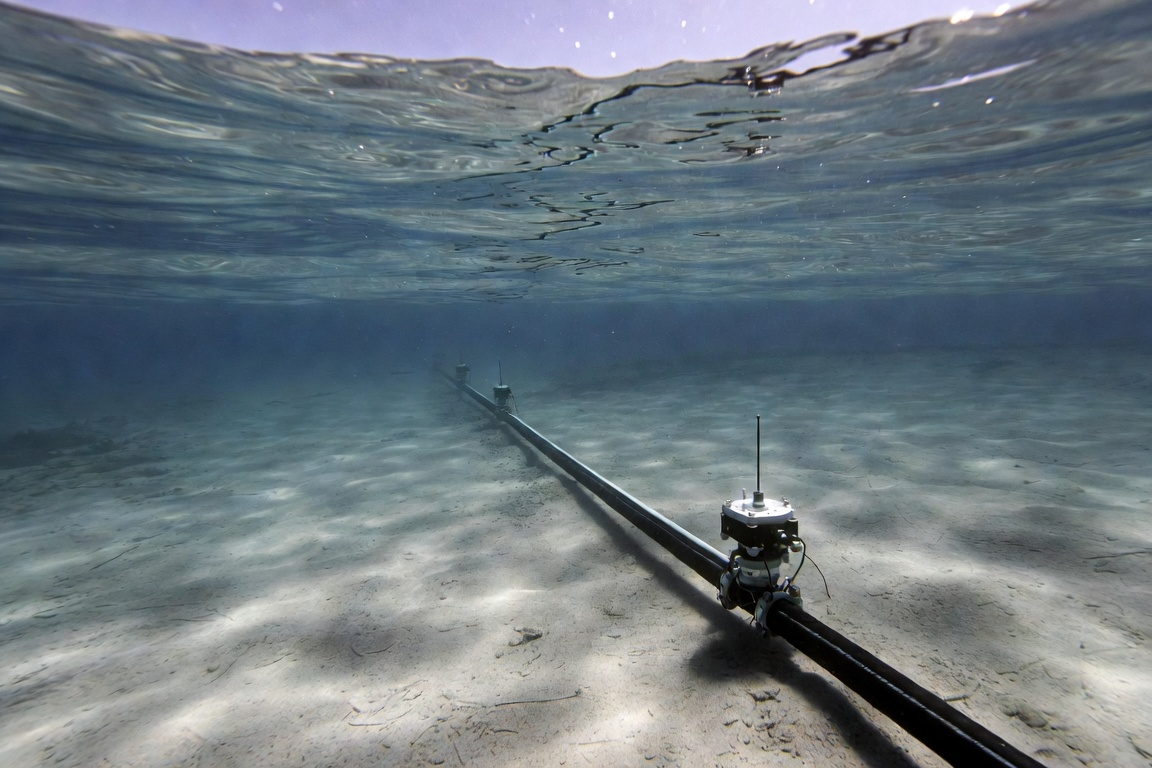
A submarine cable fault is expensive in a way that few other infrastructure failures are. The asset sits under hundreds of meters of water, the repair ship costs a fortune per day, and the vessel cannot be dispatched until somebody knows roughly where to look. Submarine cable monitoring using the fiber inside the cable itself shortens that sequence considerably.
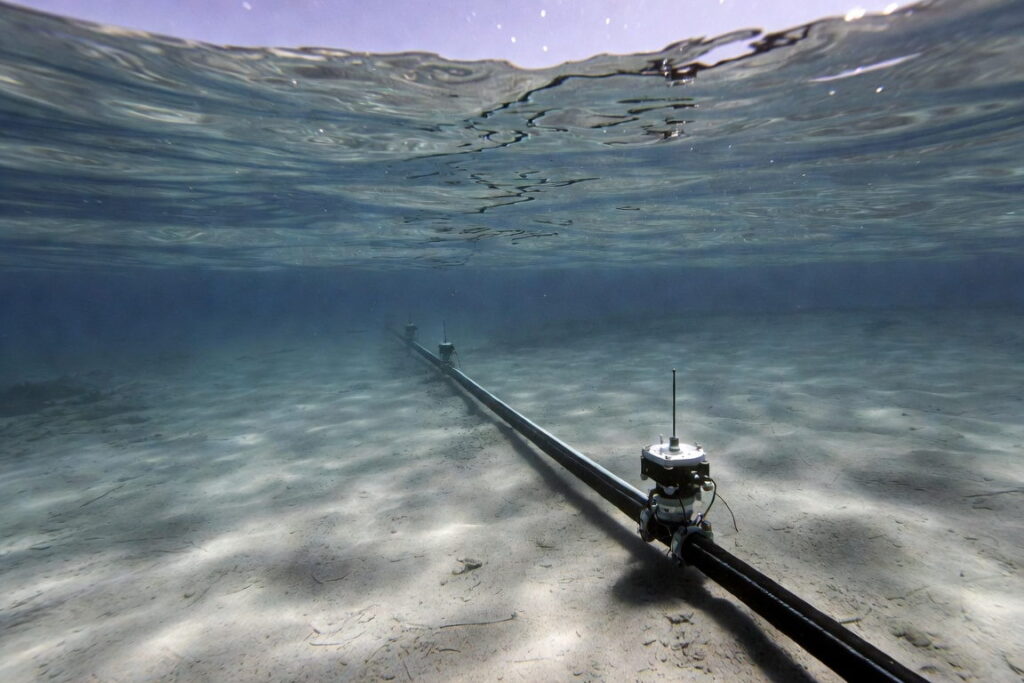
What actually damages subsea cables
The dramatic causes are the rare ones. The common causes are mundane: anchors dragged across the seabed, trawl gear catching the cable, and abrasion where the cable crosses rock. Together, external aggression of that kind accounts for the large majority of faults (ICPC), and in shallow water fishing and anchoring account for most of the damage (ICPC 2024).
That concentration is useful. The highest-risk stretch is also the most accessible one, and it is where monitoring pays back fastest.
How submarine cable monitoring reads the cable itself
Submarine cables carry optical fiber. Distributed Acoustic Sensing reads vibration along that same fiber from a landing station, with no subsea equipment to install or maintain, which matters when the alternative would need its own power and its own recovery vessel.
Three things become visible:
- Vessel activity overhead. Ship engines and propellers couple into the seabed and register as a moving acoustic source (Landrø et al., Scientific Reports 2022). A vessel slowing and holding position over the route is exactly the pattern that precedes an anchor drop.
- Contact events. Anchor or trawl gear striking the cable produces an unmistakable signature at a precise distance along the route.
- Movement and abrasion. Cable shifting in a rock crossing shows up as repeated low-level events at a fixed point, which is a maintenance signal long before it becomes a fault.
Location is the part that saves money
Traditional fault location relies on OTDR after the cable is already broken, and it tells you where the break is, not what caused it or when. Continuous monitoring gives you the location and the event that produced it, at the moment it happens. Sending a repair vessel to a known kilometer point with a known cause is a different operation from sending it to search.
Where submarine cable monitoring reaches its limits
Range is finite: a single interrogator covers up to 50 km per channel from a single end, 100 km with optical repeaters. Trans-oceanic cables are not covered end to end from a landing station, and nobody should claim otherwise. What is covered is the nearshore section, in the shallow water where fishing and anchoring cause most cable damage.
Deep-water sections need a different approach, and the honest answer for most operators is that the nearshore stretch is where the risk and the return both sit.
Starting submarine cable monitoring without a new cable
Most systems in service already contain more fiber pairs than the traffic requires. If a spare pair is available at the landing station, monitoring can start with an interrogator in an existing rack and no marine work at all. That is the fastest route to coverage, and it is worth checking before any other option is priced.
What the data looks like day to day
Operators sometimes expect a constant stream of incidents. In practice submarine cable monitoring on a nearshore section is quiet most of the time, and that quiet is itself informative: it establishes the baseline against which anything unusual stands out.
Routine traffic across the route produces a recognizable pattern. Fishing activity in the area appears seasonally. What breaks the pattern is a vessel that slows and holds position over the cable, and that is the alert worth waking someone for.
Working with vessel tracking data
Acoustic detection tells you something is overhead. AIS tells you which vessel it is. Neither is complete alone, and together they are considerably more useful than either.
The combination answers the question that matters commercially: not only that an anchor was dropped on the route, but which vessel dropped it. For operators pursuing recovery of repair costs, that correlation is often the whole reason the system gets funded.
It also covers the case AIS misses on its own, which is a vessel operating with its transponder off. An acoustic detection with no corresponding AIS track is a specific and interesting signal.
Planning a first submarine cable monitoring deployment
The practical starting point is the section between the landing station and the point where water depth exceeds the reach of anchors and trawl gear. That is where the overwhelming majority of faults occur, it sits within the range of a single interrogator, and it needs no marine work if a spare fiber pair terminates at the landing station.
Beyond that, coverage extends by adding interrogators at further landing points rather than by extending one. Scoping the first section honestly, instead of promising end-to-end coverage of a long route, is what keeps the project credible internally.
See our full approach to cable monitoring, and how the same technology protects port infrastructure.
Talk to an Engineer and tell us what you need to monitor. We will tell you whether fiber sensing is the right fit, and how to deploy it.
Frequently asked questions
What damages submarine cables most often?
The common causes are mundane: anchors dragged across the seabed, trawl gear catching the cable, and abrasion where the cable crosses rock. Together, external aggression of that kind accounts for the large majority of faults. The highest-risk stretch is also the most accessible one, which is where monitoring pays back fastest.
How does fiber sensing monitor a submarine cable?
Submarine cables carry optical fiber, and Distributed Acoustic Sensing reads vibration along that same fiber from a landing station, with no subsea equipment to install or maintain. It makes three things visible: vessel activity overhead, contact events such as anchor or trawl gear striking the cable, and movement or abrasion at a fixed point.
Can fiber sensing monitor a trans-oceanic cable end to end?
No. Range is finite, and trans-oceanic cables are not covered end to end from a landing station. What is covered is the nearshore section, between the landing station and the point where water depth exceeds the reach of anchors and trawl gear. That is where the risk and the return both sit for most operators.
Why combine acoustic detection with AIS data?
Acoustic detection tells you something is overhead, and AIS tells you which vessel it is. Together they answer not only that an anchor was dropped on the route but which vessel dropped it, which matters for recovering repair costs. An acoustic detection with no matching AIS track points to a vessel operating with its transponder off.