Fiber Optic Perimeter Security Without Blind Spots

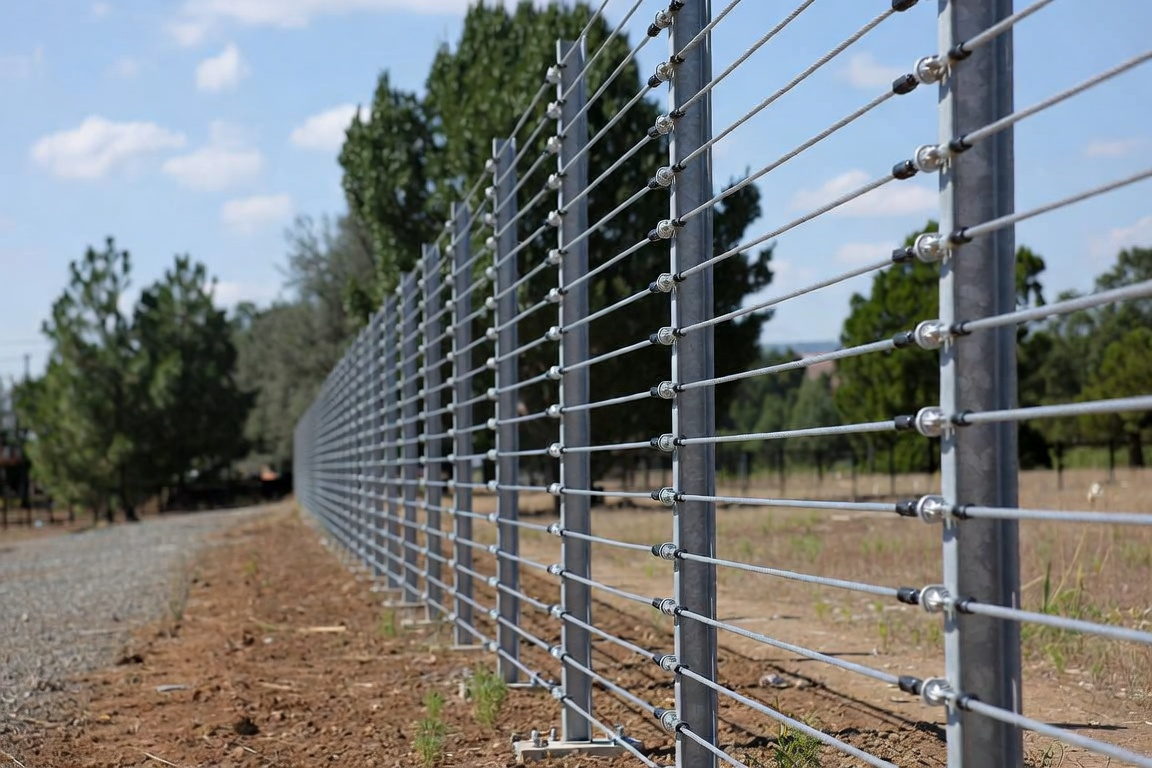
Long boundaries are hard to protect for a simple reason: the cost of conventional perimeter security scales with distance. Every camera needs power, a network drop and a viewing angle. Every motion sensor covers a fixed cone. Cover ten kilometers that way and you have built an expensive system with gaps between the cones, and the gaps are exactly where somebody will cross. Fiber optic perimeter security removes the gaps by making the boundary itself the detector.
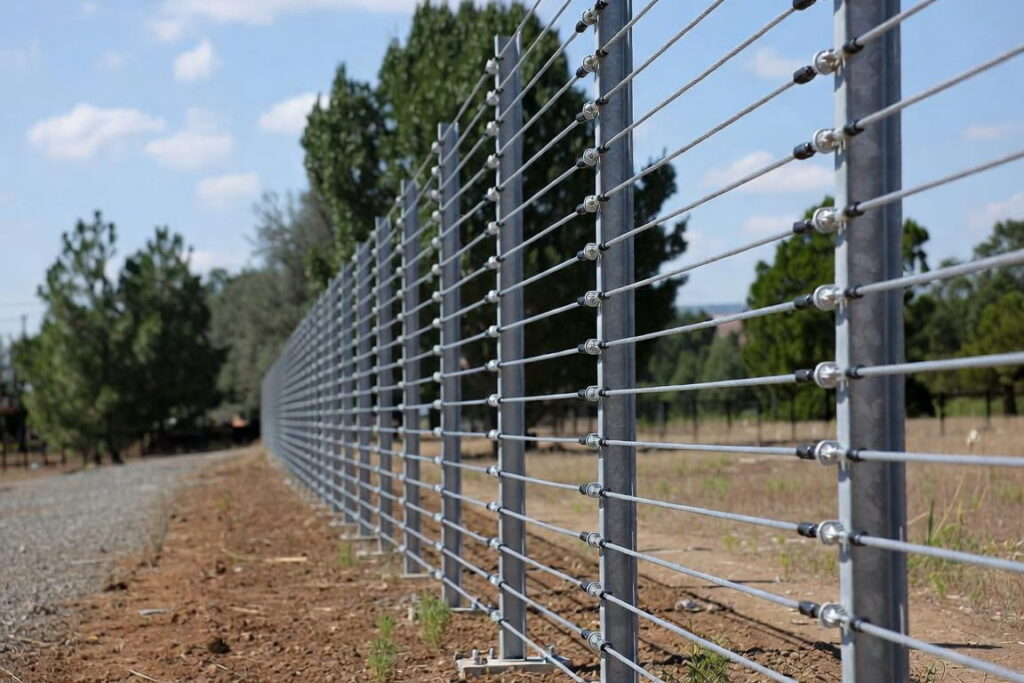
Fiber optic perimeter security as a continuous line
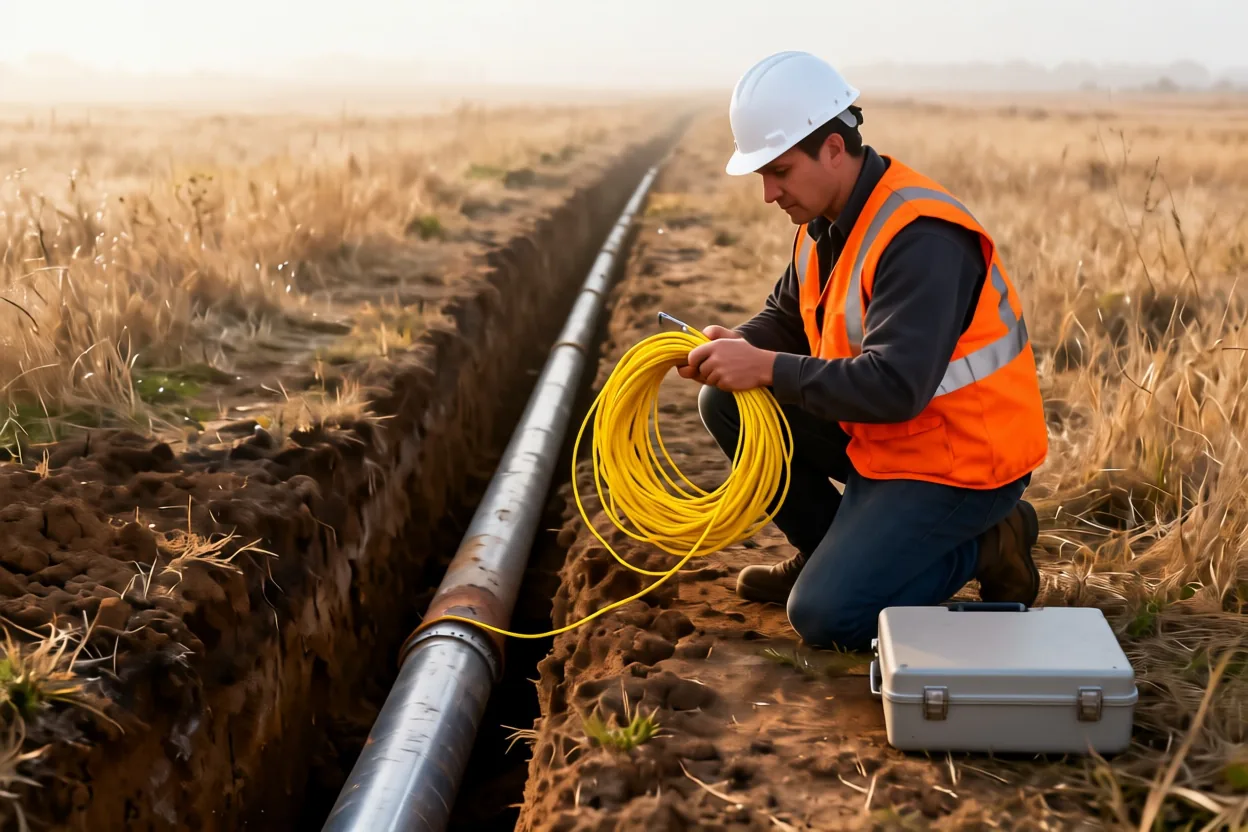
A fiber optic cable buried along a boundary (Juarez and Taylor, Applied Optics 2007), or attached to a fence, behaves as one continuous detector. A Distributed Acoustic Sensing interrogator reads the whole length from one cabinet, with channel spacing from 0.1 m and coverage of up to 50 km per channel from a single end.
There are no blind spots between sensors, because there are no discrete sensors. The cost of the next kilometer is the cost of the cable, not another powered device.
What it detects
- Footsteps near a buried cable, including a person moving slowly to avoid triggering conventional sensors.
- Fence interference: climbing, cutting, or lifting, each with a different signature.
- Vehicles approaching or stopping along the boundary.
- Digging, which matters where tunneling under the line is a realistic route.
The false alarm problem in fiber optic perimeter security
Any perimeter system that cries wolf gets ignored, and an ignored system is worse than none because it creates a false sense of coverage. The failure mode is well documented across every detection technology.
Fiber sensing does not avoid this automatically. What it offers is enough signal detail to separate causes: wind loading a fence differs from someone climbing it, and rain differs from footsteps. Getting that separation right on a specific site takes a tuning period on the live boundary, through the weather that site actually gets.
A system commissioned in dry weather and never revisited will alarm on the first storm. That is a process failure rather than a technology failure, and it is avoidable.
Working alongside what you already have
Fiber sensing is at its strongest as the detection layer feeding systems you already run. It answers the question of whether something happened and exactly where, which is precisely what a PTZ camera needs in order to be useful: a bearing and a distance.
The common configuration is fiber for detection along the full boundary, cameras for assessment at the point the fiber reports, and the existing control room for response. That combination covers everything continuously while keeping the number of cameras proportionate to the number of places anyone actually needs to look.
Where fiber optic perimeter security fits best
The economics favor long boundaries in difficult terrain: military sites, borders, airports, tank farms, substations and large private estates. Below a few hundred meters, conventional systems are usually cheaper. Above a kilometer or two, the comparison moves decisively.
Buried cable or fence-mounted
The installation choice changes what the system is good at, and it is worth deciding deliberately rather than by whatever is easier to install.
Buried cable, typically placed a short distance inside the boundary, detects approach before anyone reaches the fence. It is invisible, which matters where the deterrent value of visible security is not wanted, and it cannot be tampered with. It is also the more expensive installation.
Fence-mounted cable is the cheaper form of fiber optic perimeter security. It attaches to the existing fabric and detects contact with the fence itself: cutting, climbing, lifting. Installation is far cheaper. The trade is that it reports at the moment of contact rather than during approach, and it is exposed to weather loading on the fence.
Sites with a serious threat model often use both, with buried cable giving early warning and fence-mounted cable confirming contact.
Tuning through a full weather cycle
The single most common cause of disappointment is commissioning in benign conditions. A boundary tuned on a still, dry week will alarm on the first storm, on the first heavy rain, and on the first frost heave.
Plan for classification to be revisited across the site’s full range of conditions. That is a period of weeks or months rather than days, and it should be scheduled and staffed rather than treated as a defect that appears later.
Fiber optic perimeter security in the control room
Fiber sensing is a detection layer. Its output is most useful when it drives systems already in place: a located event steering a PTZ camera to a bearing, a map overlay showing where along the boundary it happened, and a log that supports an investigation afterwards.
Specifying that integration at the start, rather than adding a separate screen the operators have to watch alongside everything else, is what determines whether the system gets used.
Read more about security detection, or how ports combine perimeter and quayside protection on our Smart Port page.
Talk to an Engineer and tell us what you need to monitor. We will tell you whether fiber sensing is the right fit, and how to deploy it.
Frequently asked questions
How does fiber optic perimeter security work?
A fiber optic cable buried along a boundary, or attached to a fence, behaves as one continuous detector. A Distributed Acoustic Sensing interrogator reads its whole length from one cabinet. There are no blind spots between sensors because there are no discrete sensors, and the cost of the next kilometer is the cost of the cable.
What intrusions can a fiber optic perimeter detect?
Footsteps near a buried cable, including a person moving slowly to avoid triggering conventional sensors; fence interference such as climbing, cutting or lifting, each with a different signature; vehicles approaching or stopping along the boundary; and digging, which matters where tunneling under the line is a realistic route.
Should the sensing cable be buried or fence-mounted?
It depends on what the site needs. Buried cable, placed a short distance inside the boundary, detects approach before anyone reaches the fence, is invisible and cannot be tampered with, but costs more to install. Fence-mounted cable is far cheaper and detects contact with the fence itself. Sites with a serious threat model often use both.
How does fiber perimeter sensing keep false alarms down?
Not automatically. What it offers is enough signal detail to separate causes: wind loading a fence differs from someone climbing it, and rain differs from footsteps. Getting that separation right takes a tuning period on the live boundary through the full range of weather the site gets, a period of weeks or months rather than days.