DAS vs DTS vs DSS: Which Fiber Sensing Technology Fits Your Project

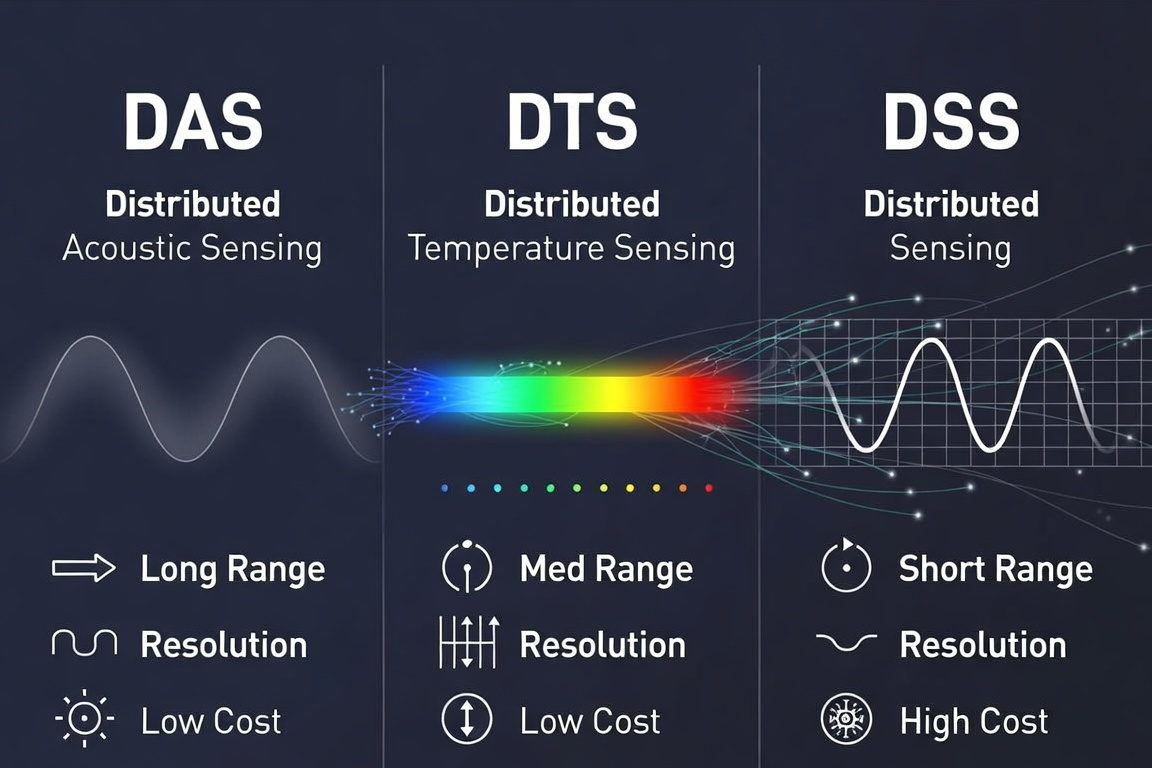
Choosing a fiber sensing technology is the first real decision in any distributed monitoring project, and it is the one most often made backwards. Teams pick a system, then discover it measures the wrong thing. DAS, DTS and DSS all turn a standard optical fiber into a continuous line of sensors, but each one answers a different question. This guide sets out what separates them, so you can match the technology to the failure you are trying to catch.
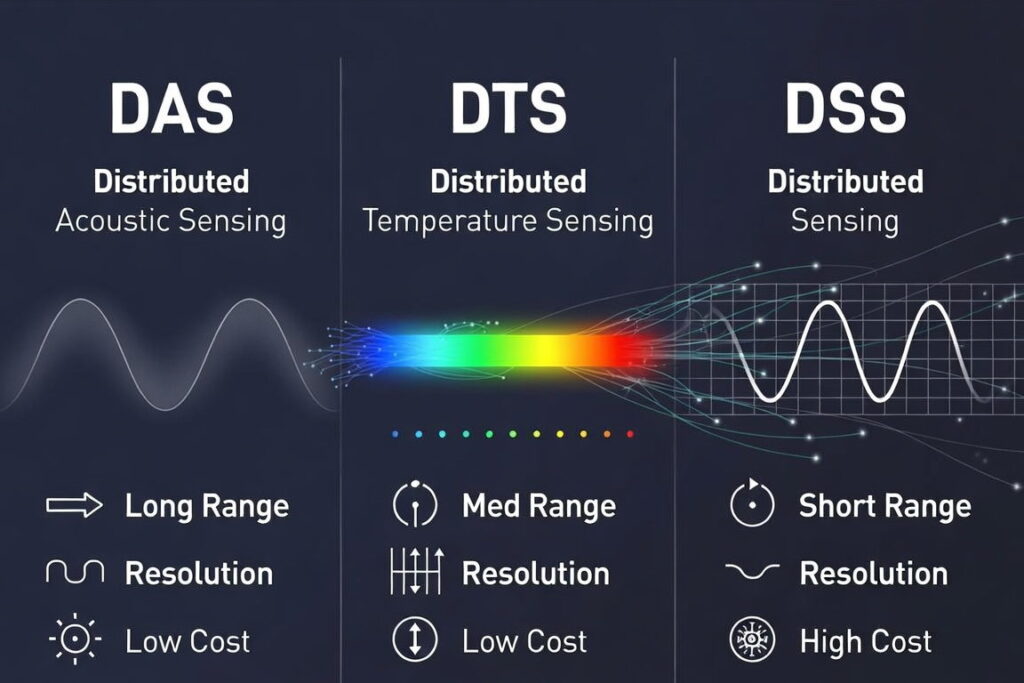
What each fiber sensing technology actually measures
The three share a principle. A laser pulse travels down the fiber, a small fraction of the light scatters back, and an interrogator at one end reads that returning light. Where they diverge is in which property of the backscatter they read.
Distributed Acoustic Sensing (DAS)
DAS reads phase changes caused by vibration and strain (Jousset et al., Nature Communications 2018). Anything that moves the fiber, a footstep, a pump, a train, a leak turning into turbulence, registers as an acoustic event at a known distance along the cable. Our Eagle DAS covers up to 50 km per channel from a single end, 100 km with optical repeaters, and samples at up to 10 kHz.
Distributed Temperature Sensing (DTS)
DTS reads Raman backscatter, whose anti-Stokes to Stokes intensity ratio changes with temperature. It gives you a temperature reading at every meter of fiber rather than at a handful of probe points (Ukil et al., IEEE Sensors Journal 2012). The Eagle DTS reaches 30 km with 0.03 °C resolution across up to 4 measurement channels.
Distributed Strain Sensing (DSS)
DSS reads static strain: slow deformation rather than vibration. Where DAS catches the moment something moves, DSS tells you that a structure has been carrying more load than it did last month.
Matching the fiber sensing technology to the failure mode
The practical question is not which system is better. It is what goes wrong on your asset, and how that failure announces itself.
- Something moves that should not. Excavators near a pipeline, someone cutting a fence, a train where no train should be. That is acoustic, so DAS.
- Something heats up or cools down. A hot spot in a power cable, fire in a tunnel, a cryogenic line losing insulation. That is thermal, so DTS.
- Something deforms slowly. A bridge deck sagging, a tunnel lining converging, a slope creeping. That is strain, so DSS.
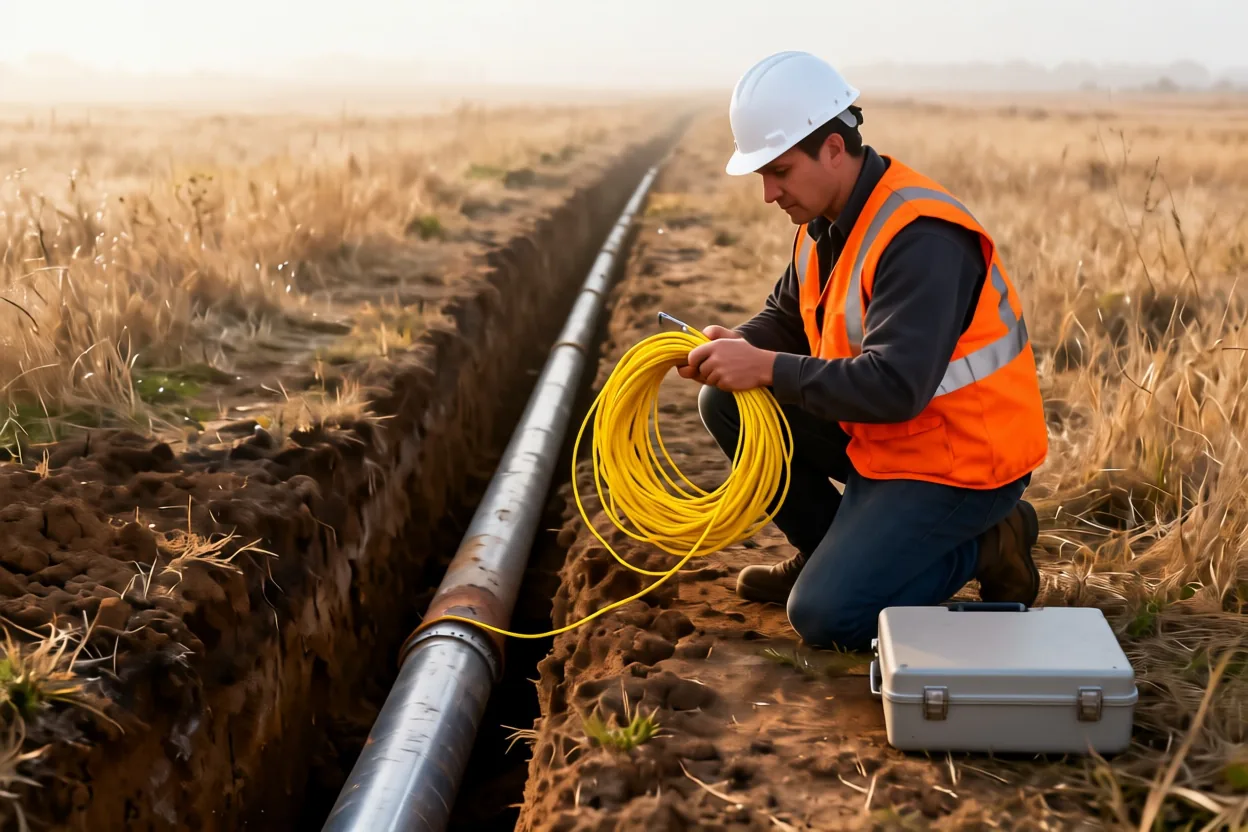
Many assets need two. A buried oil pipeline benefits from DAS for third-party interference and DTS for the thermal signature of a slow leak. Running both over the same cable is common, and it costs far less than two separate sensor networks.
What a fiber sensing technology comparison table leaves out
Datasheets compare range and resolution. Three things matter as much and rarely appear.
The fiber you already have. Telecom routes, power cables with embedded fiber and rail networks frequently include spare strands. Sensing over existing dark fiber removes the largest civil works cost from the project.
Single-ended operation. A system that reads from one end needs one cabinet, one power feed and one place to send an engineer. Systems requiring a loop double the civil works.
What happens to the data. A DAS interrogator produces an enormous stream. Without classification tuned to your site, you get alarms for every passing truck. The value is in software that distinguishes an excavator from traffic, and that is site-specific work rather than a product feature.
How to scope the fiber sensing technology decision
Start from the incident you cannot afford. Write down how it would announce itself physically, over what distance, and how quickly you would need to know. That description usually points at one technology and rules out the others in a sentence. From there, the questions are practical: how much fiber is already in the ground, where can a cabinet go, and who acts on the alarm.
Cost drivers worth understanding before you ask for a quote
Three things move the price of a distributed monitoring project, and only one of them is the interrogator.
Fiber availability. Sensing over a spare strand that already runs along the asset removes civil works entirely. Installing new cable along a 40 km route is a different order of project. This single factor often changes the total by a multiple, so it is the first thing to establish.
Channel count. One interrogator can serve several routes. A DTS unit with up to 4 channels covers four separate circuits from one cabinet, and the cost per monitored kilometer falls sharply as channels fill.
Software and classification. Detecting events is a solved problem. Deciding which events matter on your asset is site-specific work. Budget for a tuning period on the live installation, because a system that alarms on every passing truck gets muted within a month.
Questions for the first fiber sensing technology conversation
- What is the longest continuous run you need to cover, and can it be read from one end?
- Is there existing fiber along the route, and does anyone know if it is continuous?
- What event would justify the whole system on its own? That is the one classification has to get right.
- Who receives an alarm at 3 a.m., and what are they authorized to do about it?
- Does the site already have an environment for the cabinet, or is that part of the project?
Answers to those five determine most of the design. Range and resolution figures matter, but they are rarely what makes a deployment succeed or fail.
Explore how this applies to your sector on our solutions pages, or compare the instruments directly: Eagle DAS and Eagle DTS.
Talk to an Engineer and tell us what you need to monitor. We will tell you whether fiber sensing is the right fit, and how to deploy it.
Frequently asked questions
What is the difference between DAS, DTS and DSS?
All three turn a standard optical fiber into a continuous line of sensors by reading light scattered back to an interrogator, but each reads a different property. DAS reads phase changes caused by vibration and strain, DTS reads Raman backscatter, which changes with temperature, and DSS reads static strain, meaning slow deformation rather than vibration.
How do I choose between DAS, DTS and DSS?
Start from the failure mode. If something moves that should not, such as an excavator near a pipeline, that is acoustic, so DAS. If something heats up or cools down, such as a hot spot in a power cable, that is thermal, so DTS. If something deforms slowly, such as a sagging bridge deck, that is strain, so DSS.
Can DAS and DTS run on the same cable?
Yes, and many assets need two. A buried oil pipeline, for example, benefits from DAS for third-party interference and from DTS for the thermal signature of a slow leak. Running both over the same cable is common, and it costs far less than two separate sensor networks.
What drives the cost of a distributed fiber sensing project?
Three things, and only one of them is the interrogator. Fiber availability comes first: sensing over a spare strand along the asset removes civil works entirely. Channel count is second, because one interrogator can serve several routes. Third is software and classification, which is site-specific work that needs a tuning period on the live installation.