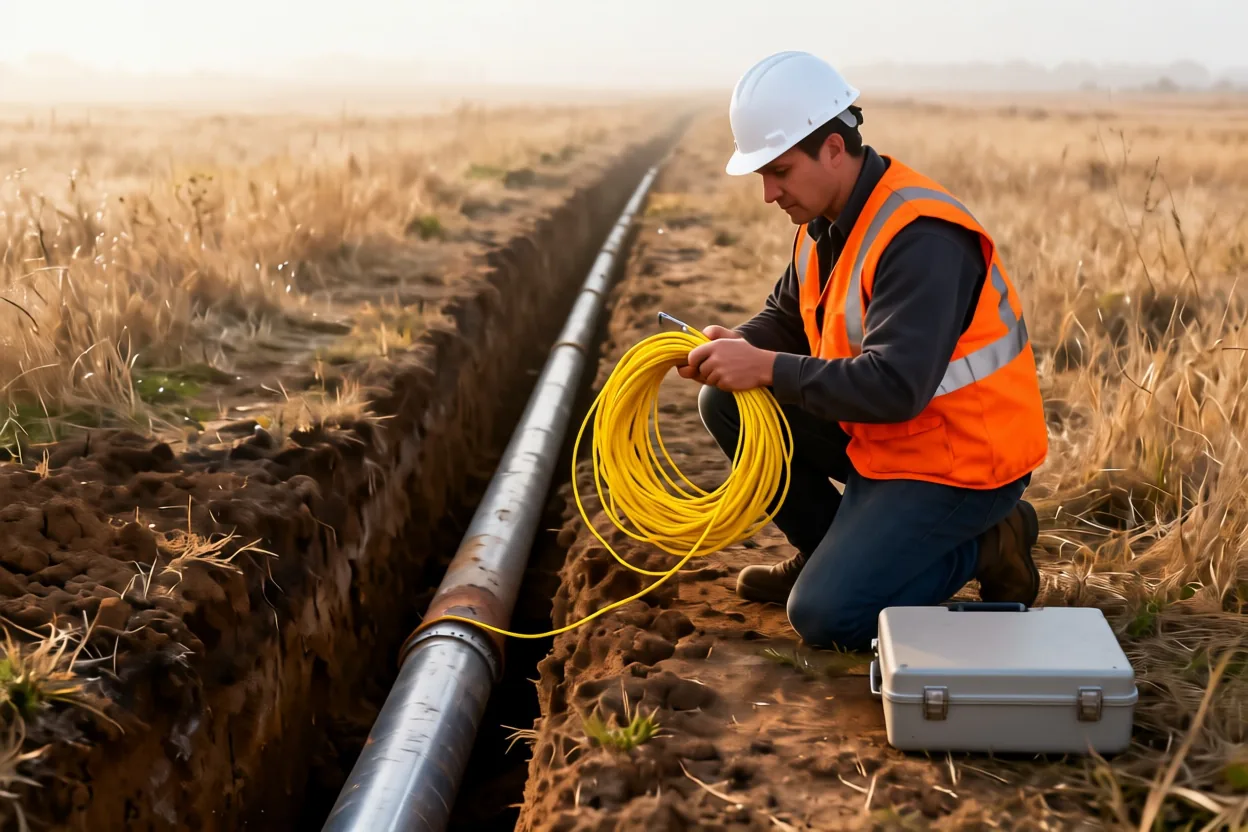
Mexico’s Illegal Taps Are Rising: The Case for Fiber Optic Pipeline Monitoring


On 21 August, in a farm plot next to the Parque San Mateo subdivision in Cuautitlan, State of Mexico, authorities found two high pressure quick closing valves connected to a duct of roughly 12 inches on the Tula-Azcapotzalco branch. The operation involved the State of Mexico Security Secretariat, the National Guard and specialised Pemex personnel, and a tanker truck presumably loaded with diesel was secured. There were no arrests at the time of the closure, and the case is one more argument for pipeline monitoring in Mexico that reports before the loss, not after it, according to Infobae Mexico. The installation was already built and running when it was found, and that is the precise gap that fiber optic pipeline monitoring exists to close.
Five days earlier, in the community of Xolostitla, municipality of Epazoyucan, Hidalgo, on the Pachuca-Tulancingo highway, a Pemex crew was working to disable another illegal tap when the duct exploded. Two people were injured with burns and nearby homes were evacuated as a precaution, with state and municipal police, the National Guard, Sedena, firefighters and Civil Protection all involved, as reported by El Universal.
Two events, ten days apart, with the same structural problem behind them: the anomaly was handled after the fact, not while it was forming. For an operator, that is not a security statistic. It is a detection window that was never opened.

Where the official numbers say pipeline monitoring in Mexico should start
Between January and April 2026, Pemex detected 3,836 illegal taps, against 3,699 in the same period of 2025, an increase of 3.7 percent, or 137 additional cases, according to records from the company’s Subdireccion de Salvaguardia Estrategica. Hidalgo leads with 986 cases, followed by Jalisco with 740 and Puebla with 362. Michoacan shows the sharpest relative move, from 9 cases to 23, a rise of 155.56 percent.
Read as a procurement input rather than as a headline, that distribution is the useful part. Nobody instruments a national network in one step, and no budget approves one. A breakdown by state tells you which corridor carries enough incidence to justify a first instrumented segment, and a jump like Michoacan’s tells you where the problem is moving rather than where it already is. Those are two different decisions and they usually belong to two different fiscal years.
What fiber optic pipeline monitoring actually detects
Pipeline monitoring in Mexico on distributed sensing turns the optical fiber running along the route into a continuous sensor. There is no chain of discrete devices to power, calibrate and maintain along hundreds of kilometres: the fiber is the instrument, and a single interrogator at one end reads the whole length of it. Depending on what the signal is read for, the same cable can report acoustic and vibrational energy (distributed acoustic sensing, or DAS), temperature (DTS) or strain (DSS).
That matters for illegal taps because hot tapping is not instantaneous. Excavating, drilling and fitting valves like the ones found in Cuautitlan is hours or days of mechanical work carried out against the pipe wall. Work of that kind produces vibration while it is happening, in a location that does not move. The technical problem is therefore not whether something is audible, but whether the system can separate that activity from farm machinery, road traffic and legitimate maintenance, and report it with a usable location instead of a general alarm. That is a classification problem, and it is where the analytics layer over the signal earns its place.
Pipeline monitoring in Mexico has two caveats that belong in the same paragraph as the promise, because this audience checks. Detection distance and location accuracy are not universal constants: they depend on the type and condition of the fiber, the quality of splices and enclosures, how the cable is coupled to the ground along the route, and the models applied to the signal. Any supplier quoting a single number valid for every installation is quoting a brochure. The answer that means anything is the one produced for a specific segment, which is what a feasibility study on that segment is for. Our pipeline monitoring and DAS interrogator pages set out the scope of what is assessed.
The same principle, tested well outside the pipeline sector
On 13 August, an analysis in The Conversation examined damage to the Indigo West and Indigo Central subsea cables, which occurred inside the Perth Submarine Cable Protection Zone, an area extending more than 100 kilometres offshore. The authors note that if distributed acoustic sensing had been deployed on those cables, the vessel responsible for the fault could have been identified almost immediately. Australia depends on around 22 subsea cables that carry more than 95 percent of its international internet traffic, as the article sets out.
Different asset, identical argument, and the one that carries over to pipeline monitoring in Mexico: fiber does not only transport, it also testifies. The reason that case is worth citing in a pipeline article is that it removes the sector from the equation. Nothing about the physics is specific to hydrocarbons, which is also why the same technique appears in cable monitoring work.
The technology is also past the demonstration stage in utility procurement. AP Sensing is presenting distributed fiber optic sensing for underground and submarine power cables, overhead transmission lines and other critical grid assets at the CIGRE Paris Session 2026, held from 23 to 28 August at the Palais des Congres, stand B84, per its own announcement. CIGRE is the reference forum of the global power sector, and distributed sensing having its own stand there is a reasonable answer to any buyer in the region hearing about this for the first time.
Pipeline monitoring in Mexico is being decided now, at the design stage
On 11 August, Google announced three new subsea cable systems under Americas Connect: Alisios, connecting the Dominican Republic, Panama and Chile; Canoa, joining the Dominican Republic with Bermuda and linking into the Nuvem and Sol cables toward Europe and North America; and OlaLuz, running from the Dominican Republic directly to Florida, plus a new branch of the Firmina cable landing in the Dominican Republic, according to the Google Cloud announcement.
The Panama Maritime Authority, for its part, reports that global investment in subsea cables will exceed 16 billion dollars between 2026 and 2029, counts seven cable systems currently operating in Panamanian waters, and describes the TAM-1 system, which arrived in early 2026 with 650 terabits per second of capacity over roughly 7,000 kilometres. The same note cites losses of more than 11 million dollars from incidents between 2008 and 2019, in its press release.
The operational consequence is unglamorous and easy to miss. Whether spare fibers are left available for sensing is settled while a route is being designed, not once it is buried. Every kilometre being laid across the region this year is a potential sensor, and the cost of keeping that option open at design time is not comparable to the cost of opening a trench later to recover it.
What to do about pipeline monitoring in Mexico if you run a linear asset
Three steps, in this order, and none of them require a network wide commitment.
- Establish whether fiber already runs along the right of way, and under what terms it could be read. Where it exists, that route is the cheapest possible entry point, because the sensor is already installed.
- Choose one segment by incidence, not by length. The state level figures above are enough to argue that choice internally, which matters when the budget owner is not the person losing product.
- Ask for a proof of concept on that fiber, with the event types you actually need to tell apart written into the acceptance criteria. If a supplier will not commit to criteria in writing before installing, that is information too.
BiiSensing is the BiiSmart Group unit dedicated to intelligent fiber optic monitoring and to the analysis of the data it produces, and the first company in Latin America operating in this field. In practice that means assessing the viability of a specific stretch, running proofs of concept over fiber that is already in the ground, and staying with the project from the initial survey through commissioning. If you want to know whether a route is a candidate, three pieces of information start the conversation: its length, the fiber that runs along it, and the events you need to distinguish. Send those three and we work from there.
Frequently asked questions
Why can fiber sensing detect illegal taps on a pipeline?
Hot tapping is not instantaneous. Excavating, drilling and fitting valves is hours or days of mechanical work carried out against the pipe wall, and it produces vibration while it is happening, in a location that does not move. Distributed acoustic sensing reads that vibration along the optical fiber that runs with the route.
What is the hard part of detecting tapping with fiber?
Not whether the activity is audible, but whether the system can separate it from farm machinery, road traffic and legitimate maintenance, and report it with a usable location instead of a general alarm. That is a classification problem, and it is where the analytics layer over the signal earns its place.
Is detection distance the same on every pipeline?
No. Detection distance and location accuracy depend on the type and condition of the fiber, the quality of splices and enclosures, how the cable is coupled to the ground along the route, and the models applied to the signal. The answer that means anything is the one produced for a specific segment.
Where should a pipeline operator start?
Establish whether fiber already runs along the right of way, and under what terms it could be read. Choose one segment by incidence, not by length. Then ask for a proof of concept on that fiber, with the event types you need to tell apart written into the acceptance criteria.