Fiber Optic Sensing for Transmission Line Monitoring: the Sensor Is Already on the Tower

The fiber sensing industry spent this week in Paris, and the subject it brought was the power grid, not oil and gas. FEBUS Optics is exhibiting DAS, DTS and DSS for power and telecom cables until 28 August, in Hall 1, Booth A53. Ampacimon is at Booth A30 of the same CIGRE 2026 Session with a dynamic line rating solution built on OPGW. Fiber optic sensing for transmission line monitoring has moved from conference paper to commercial offer on the show floor.
For a Latin American transmission operator, that timing matters for two reasons at once. Copper theft is taking lines out of service, and grid saturation is holding back renewable expansion. Both problems are measurable today, and both are already costing money. Therefore the useful question is no longer whether fiber can sense, but what it can sense on an asset that is already built and energised.
The answer starts with a cable that almost every high voltage line already carries.
The sensor is already strung on the tower
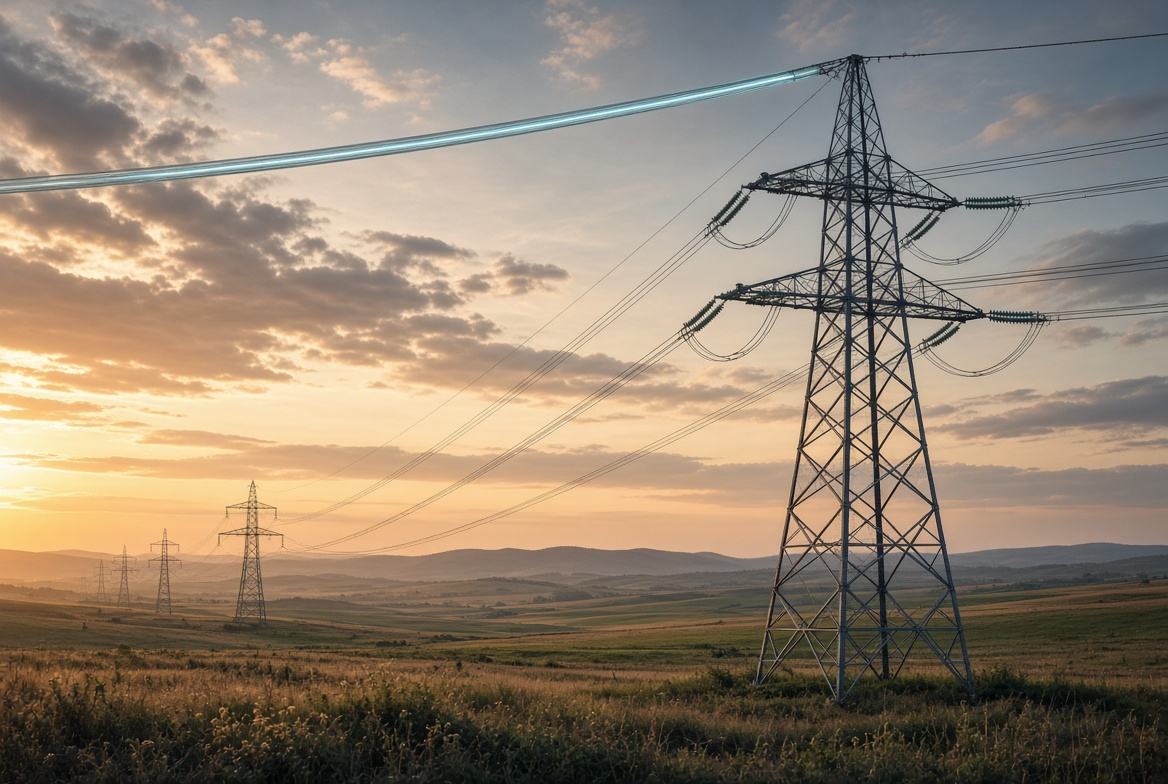
Most overhead transmission lines carry an optical ground wire, or OPGW: a shield wire with optical fibers inside the core. It goes up on the day the line enters service, and it usually carries telecom traffic or nothing at all. In February 2026, AP Sensing and Ampacimon announced a joint solution that uses exactly that fiber. DTS reads temperature along the cable. DAS reads vibration and derives wind conditions, third party interference and weather events, with no sensors mounted on the conductors.
That is the whole point of the angle, in short. There is no new trench, no work at height and no separate sensing cable to pull. The entry barrier is an interrogator in a substation plus the engineering to connect it, not a construction project. Ampacimon reports coverage of up to 100 km from a single hardware unit, so one substation can watch a full line section. The same reasoning applies to buried and submarine circuits, which is why cable monitoring and overhead lines are converging on the same instrument.

Conductor theft leaves a signature on the fiber
Chile gives the clearest number for the first pain. For example, take the theft corridors of the central zone. Transelec reported 100 thefts, 85 tonnes of stolen copper and more than 2,000 hours spent on repairs so far in 2026. Full year 2025 closed with 184 thefts, 112 tonnes and more than 4,000 hours of repair work. David de Pablo, the company’s Central Zone manager, called the situation unsustainable and said Transelec is asking the authorities for support.
What that report does not mention is any early detection technology in service. The gap matters, because theft is a physical sequence: someone climbs a tower, cuts, and drags the conductor away. Each of those steps is mechanical, and mechanical events near the fiber are what distributed acoustic sensing measures. Detection is not automatic, of course, and no serious vendor should claim otherwise. It depends on the mechanical coupling between fiber and structure, on the distance to the interrogator, and on how well the vendor trained the event library for that route. However, the physics works in the operator’s favour, which is more than a patrol schedule can offer.
Fiber optic sensing for transmission line monitoring also releases capacity
The second use case pays for itself in a different currency. Instead of avoided losses, it counts delivered megawatts. Static line ratings assume conservative ambient conditions, so a line runs below what the weather of the moment would allow. Dynamic line rating uses live temperature and wind data to recalculate that limit. That is why distributed temperature sensing sits next to DAS in these deployments, and why the two techniques share one fiber.
Ampacimon reports 20 to 40 per cent of capacity released, software coverage of more than 1,500 lines, and sensors on more than 250 lines worldwide. In the PPL case it reports USD 76 million of congestion savings in one year. In the Elia case, 22 per cent of additional cross border exchange capacity. For an operator that cannot build a new line in less than five years, that is the short term lever available. In addition, it works on an asset the operator already paid for, so the case rests on avoided congestion rather than on new capital expenditure.

Brazil is deciding 1,866 km of sensable fiber right now
ANEEL approved the edital for a transmission auction with R$ 8.9 billion in investment, roughly 1,866 kilometres of lines and 13,144 MVA of transformation capacity across seven states. The edital publishes on 30 September 2026, the auction runs on 30 October, and contract signature falls in February 2027.
As a result, every one of those kilometres will carry OPGW by design. That is 1,866 km of sensable fiber. The winning bidders set the monitoring scope now, at project stage, when adding an interrogator costs a fraction of a retrofit. In other words, fiber optic sensing for transmission line monitoring is a design decision on this auction, not an upgrade to negotiate in 2030. The cheap window closes with the contract, not with the energisation.
The interrogator is not the differentiator, the analytics are
Two publications from the last two months show where the real work sits. In both cases, the value comes from the processing layer. Researchers at Penn State, publishing in Science Advances, turned 4 kilometres of ordinary underground telephone cable into the equivalent of more than 2,100 independent detectors. Over 30 months they recorded signals down to 100 metres of depth and captured 458 clean events. If a city telephone cable does that with no special engineering, the OPGW of a 220 kV line is a comparable sensing medium.
Meanwhile Marlinks released the Marlinks-NS dataset. It pairs processed subsea DAS measurements with AIS vessel information, and it defines two machine learning tasks: vessel detection, and vessel to cable distance estimation. That is the competitive frontier, and it is not the hardware. A raw trace is not an alarm, and a control room cannot act on one. AP Sensing made a similar point in July at the Potsdam Conference for National Cybersecurity. There it showed fiber sensing detecting unauthorised access and fire events during a simulated sabotage scenario. For a utility, therefore, the question to a vendor is blunt. Do you deliver a waterfall plot, or classified events with a false alarm rate you will state in writing?
How to test this on your own line
In practice, the path is narrow and it starts small. First, confirm what fiber the line already has. That means core count in the OPGW, how many strands stay dark, and where the splices and substation terminations sit. Second, pick one span with documented pain, either a theft corridor or a congested section, and instrument that span only. Third, define in advance what counts as a detection and what counts as a false alarm, because that definition is what a pilot actually validates.
BiiSensing works on that sequence: viability assessment of a specific span, proof of concept over fiber already in place, and support from the initial survey through to commissioning. Do you operate transmission lines in the region? Then talk to an engineer about fiber optic sensing for transmission line monitoring on your own route, and about what your existing OPGW can measure today.
Frequently asked questions
Can transmission lines be monitored with the fiber they already carry?
Yes. Most overhead transmission lines carry an optical ground wire, or OPGW, a shield wire with optical fibers inside its core. DTS reads temperature along that cable and DAS reads vibration, with no sensors mounted on the conductors, no new trench and no work at height: the entry barrier is an interrogator in a substation.
Can fiber sensing detect conductor theft?
Theft is a physical sequence: someone climbs a tower, cuts, and drags the conductor away, and each step is a mechanical event near the fiber that distributed acoustic sensing measures. Detection is not automatic. It depends on the coupling between fiber and structure, the distance to the interrogator and the event library trained for that route.
What is dynamic line rating?
Static line ratings assume conservative ambient conditions, so a line runs below what the weather of the moment would allow. Dynamic line rating uses live temperature and wind data to recalculate that limit, which is why distributed temperature sensing sits next to DAS in these deployments, with the two techniques sharing one fiber.
What should a utility ask a fiber sensing vendor?
Whether they deliver a raw waterfall plot, or classified events with a false alarm rate they will state in writing. A raw trace is not an alarm, and a control room cannot act on one. In a pilot, define in advance what counts as a detection and what counts as a false alarm.