Smarter Gas Networks in a Changing Regulatory Landscape
Gas distribution is being asked to do something new while proving it is safer than before. Hydrogen blending and biomethane change what flows through the network, emissions targets change what counts as an acceptable loss, and resilience requirements change what an operator has to be able to demonstrate. Fiber optic sensing for gas networks is relevant to all three at once, because it produces a continuous, positioned record of what the network is doing.
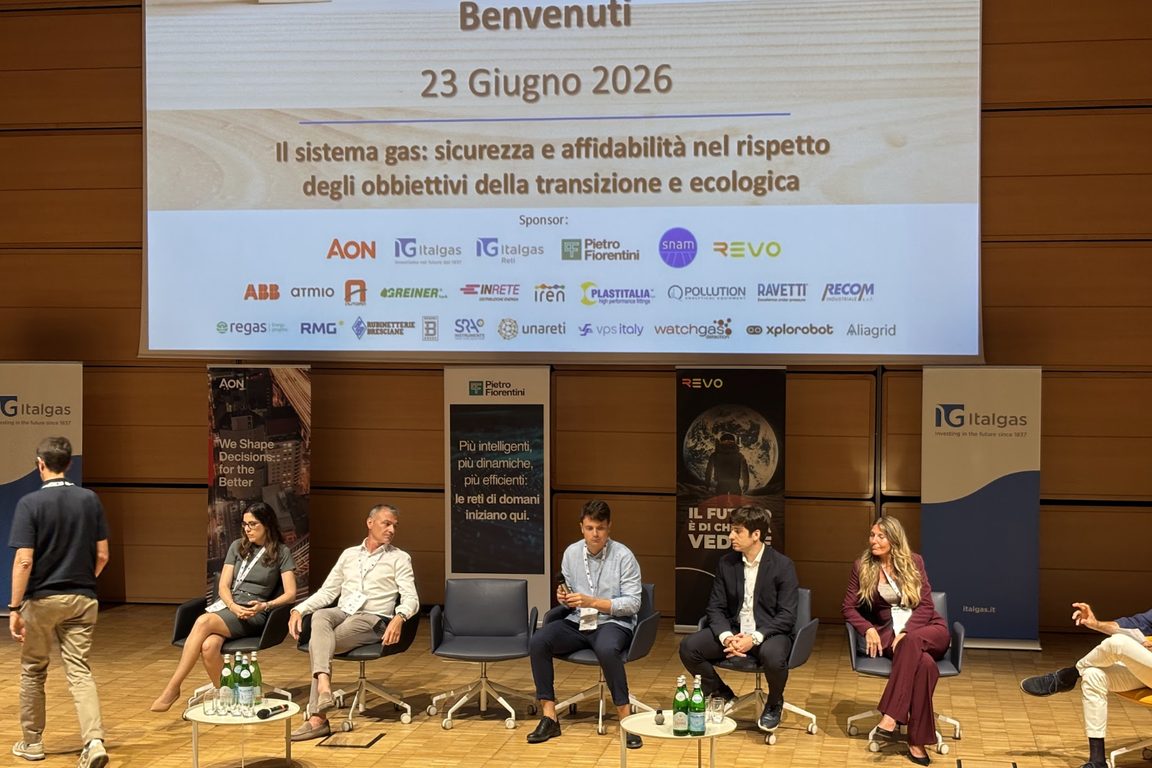
BiiSensing took part in the sixteenth edition of Forum UNI-CIG in Milan on 23 June, held under the theme Il sistema gas: sicurezza e affidabilità nel rispetto degli obiettivi della transizione ecologica. The program moved between sector development, the role of green gases in heating, incidents in domestic installations and consumer protection, which is a reasonable map of where the pressure on operators is coming from.

Fiber optic sensing for gas networks makes compliance measurable
Regulation increasingly asks operators not just to be safe, but to show the evidence. That distinction matters for instrumentation choices. A method that detects a condition without recording where and when it occurred satisfies the first requirement and not the second.
Distributed sensing produces the record as a side effect of how it works. Light is sent down a standard fiber in the trench and the backscatter is read continuously, so every measurement carries a position along the route and a timestamp. What accumulates is a per-location history, which is the form a regulator, an insurer and a maintenance planner all want.
What fiber optic sensing for gas networks detects
Third-party interference. Excavation near a buried line is the dominant cause of serious damage in distribution networks. Our Eagle DAS reads acoustic energy along up to 50 km of fiber per channel from a single end, 100 km with optical repeaters, at acquisition rates up to 10 kHz. Mechanical digging above a pipe has a distinct signature, and it is detectable before the tool reaches the pipe rather than at the moment of contact. We wrote about that specific case here.
Leaks. A pressurized escape generates both sound and a local temperature change. Reading acoustics with DAS and temperature with Eagle DTS, which resolves 0.03 °C over up to 30 km across up to 4 channels, gives two independent indications of the same event, which is what keeps a false alarm rate workable on a live network.
Ground movement. Subsidence, landslide and settlement load a buried line mechanically long before anything ruptures. Fiber optic sensing for gas networks gives that loading a location, delivered in purpose-built configurations per asset.
Hydrogen and biomethane raise the bar
Introducing hydrogen into an existing network changes the molecule the network was designed around. It is smaller, it has a wider flammability range, and it interacts differently with some materials. None of that makes distributed sensing behave differently, which is the useful part: the fiber is measuring vibration, temperature and strain in the trench, not composition in the pipe. A monitoring layer specified today does not need to be respecified when the blend changes.
Biomethane brings a different issue, which is topology. Injection points multiply and flows stop being unidirectional, so the assumptions behind pressure-based leak inference weaken. A method that measures along the asset rather than inferring from end points is less sensitive to that change.
The number that gets fiber optic sensing for gas networks approved
Operators rarely fund monitoring on safety alone, so it is worth being direct about the operating case. Continuous coverage lets routine patrol be replaced by response to a flagged location. Detection while an event is small avoids the cost of one that is not. Locating to within about a meter means excavating once. And a per-location history lets replacement capital be aimed at the sections that are actually degrading, which on an ageing distribution network is usually where the largest saving sits.
Fiber optic sensing for gas networks uses the cable already in the trench
Distribution and transmission networks were largely built with a communications cable alongside the pipe, for telemetry and control. In most cases not every strand is in use. Those spare strands can frequently be read as a sensing asset without opening ground, which matters more here than in almost any other sector: on a gas network the civil work is the dominant cost and the dominant permitting problem, and in this case it is already done.
That changes how a programme can be staged. Rather than a network-wide capital request, an operator can instrument the sections where the consequence is highest, using fiber that already exists, and extend coverage as the record justifies it. We wrote about reading dark fiber this way.
More on the approach in pipeline monitoring.
Event details
- Event: Forum UNI-CIG 2026, sixteenth edition
- Date: 23 June 2026, 09:30 to 17:00
- Venue: Via Monte Rosa 91, Milan, Italy
- Organizer: CIG, Comitato Italiano Gas
- Theme: Il sistema gas: sicurezza e affidabilità nel rispetto degli obiettivi della transizione ecologica
Talk to an Engineer and tell us what you need to monitor. We will tell you whether fiber sensing is the right fit, and how to deploy it.